Table of Contents
It has a furry tail, it’s sitting on your deck in broad daylight, and things keep going missing from the shed. That’s a pack rat, also called a woodrat, and how to get rid of pack rats is a different job from the rats most pest-control pages are writing about.
Woodrats are native wildlife, not the Norway and roof rats that raid garbage. They come for shelter and nest material. They build a bulky stick nest (a midden) in a woodpile, under a deck, in an attic or in a car that never moves. So the job has three parts: catch or evict the animals, close the way in, and clear the nest safely so the next one doesn’t move in.
One catch before you start. Some states protect woodrats, and two subspecies are federally endangered, so the first job is checking what you’ve got and what your state allows.
1. Check the tail first
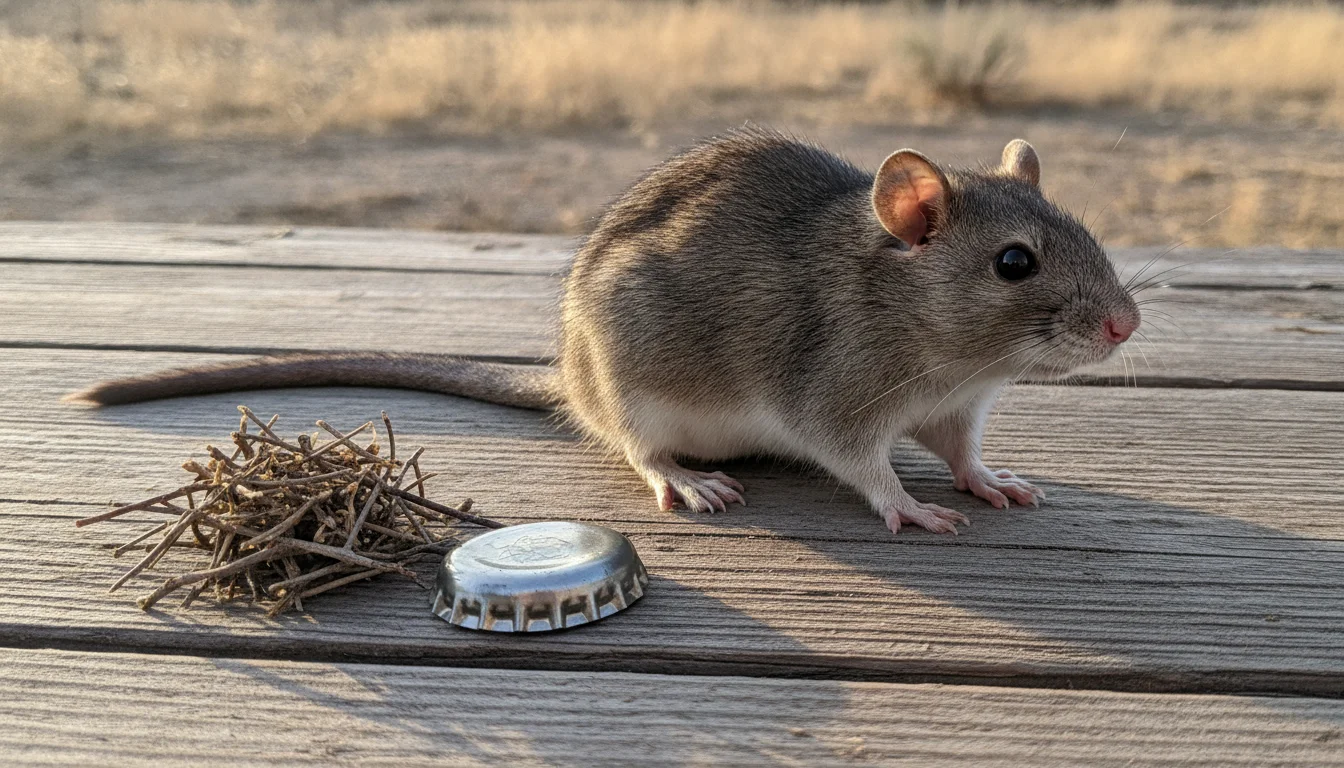
A woodrat’s tail is covered in fur. A Norway rat or roof rat has a scaly, mostly bare one. That one look tells you which advice to follow (for the scaly-tailed kind, see our guide to getting rid of rats).
Other giveaways: big rounded ears, large dark eyes, soft fur and a white belly and feet. Adults run about 12 to 17 inches (30 to 43 cm) including the tail. And they collect small shiny things (coins, foil, jewelry), often leaving a stick or nut in trade.
Then check your state’s rules. Colorado treats woodrats as protected nongame animals unless they’re causing a nuisance or property damage. When they are, Colorado Parks and Wildlife lets you trap rats doing damage with live or body-hold traps, but city, county and HOA rules can be stricter, so check those too. Kansas lets homeowners, landowners and tenants control them when they damage property. University of Arizona extension says Arizona homeowners can act without contacting wildlife officials first. The Key Largo woodrat in Florida and the riparian woodrat in California’s San Joaquin Valley are federally endangered. If you live in either range, don’t trap anything; call the U.S. Fish and Wildlife Service or your state wildlife agency.
2. Find the nest before you do anything else
This is what the sales pages skip. The nest is why the animal stays, and an empty one draws the next tenant.
Follow the droppings, urine stains, smell and piles of sticks or collected junk. Outdoors, look in woodpiles, brush and rock piles, under decks and sheds, at the base of shrubs and inside cactus clumps. Under cover, check attics, garages, crawl spaces, stacked boxes and the engine bay of anything that sits.
Ground nests often reach 3 to 5 ft (0.9 to 1.5 m) high and across, and one animal may use several. A writer for Grit who deals with these animals in storage areas and engine bays reads the droppings to tell an active nest from an old one: dark brown, hard and smelly means recent, while cardboard-colored means it’s been there a while.
Map them. Don’t dig in yet, and don’t set one on fire (nests often sit over roots that can smolder underground for weeks).
3. Trap them with rat-sized snap traps
Inside a building, traps are the main tool. Extension services in Colorado and Kansas both say most woodrat problems in structures can be handled with the standard rat snap trap, and Colorado State notes they show little fear of new objects.
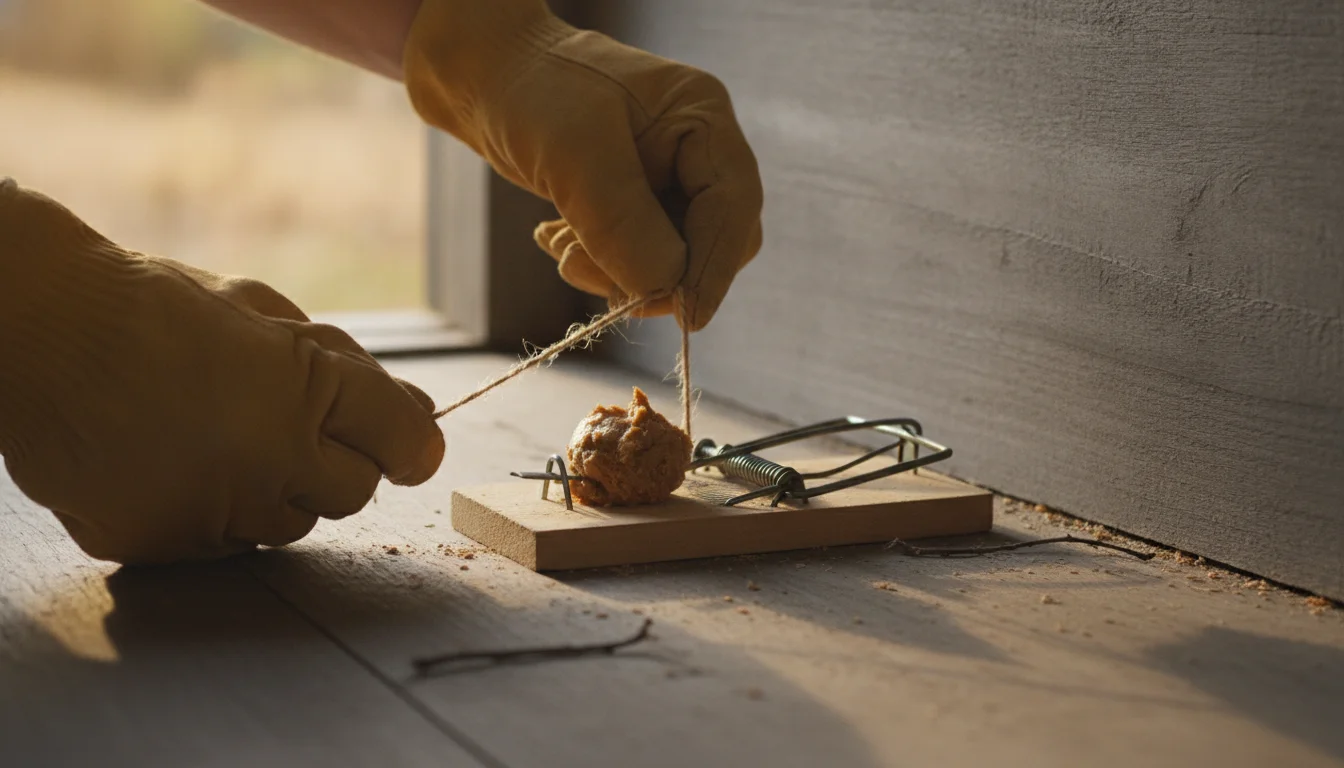
Bait with nuts, bacon rind, peanut butter mixed with oatmeal, raisins or other dried fruit. Tie or wedge the bait onto the trigger so the animal has to work at it. Kansas State recommends pre-baiting: leave the traps baited but unset for several days, then set them. Put them along the trails you mapped, near the nest and against walls, out of reach of kids and pets.
You may not need many catches. A woodrat’s home range is about 100 ft (30 m) across, and Kansas State notes that catching one or two often stops the damage.
They’re not always easy, though. The Grit writer has had almost no luck with the classic wooden rat trap (it jumps or flings the animal clear) and none with plastic jaw-style traps. If a setup keeps missing, move or change it.
Skip glue boards outdoors, where they catch whatever wanders by. And think twice before live-trapping to release elsewhere: University of Arizona extension advises against it because released animals often die from exposure, predators or fights with resident animals.
4. Seal every way in
University of Arizona extension calls exclusion the most effective fix when woodrats are getting into buildings. They’re agile climbers, so check high as well as low: attic vents, broken shingles, gaps at the eaves, utility lines, crawl space vents and foundation cracks.
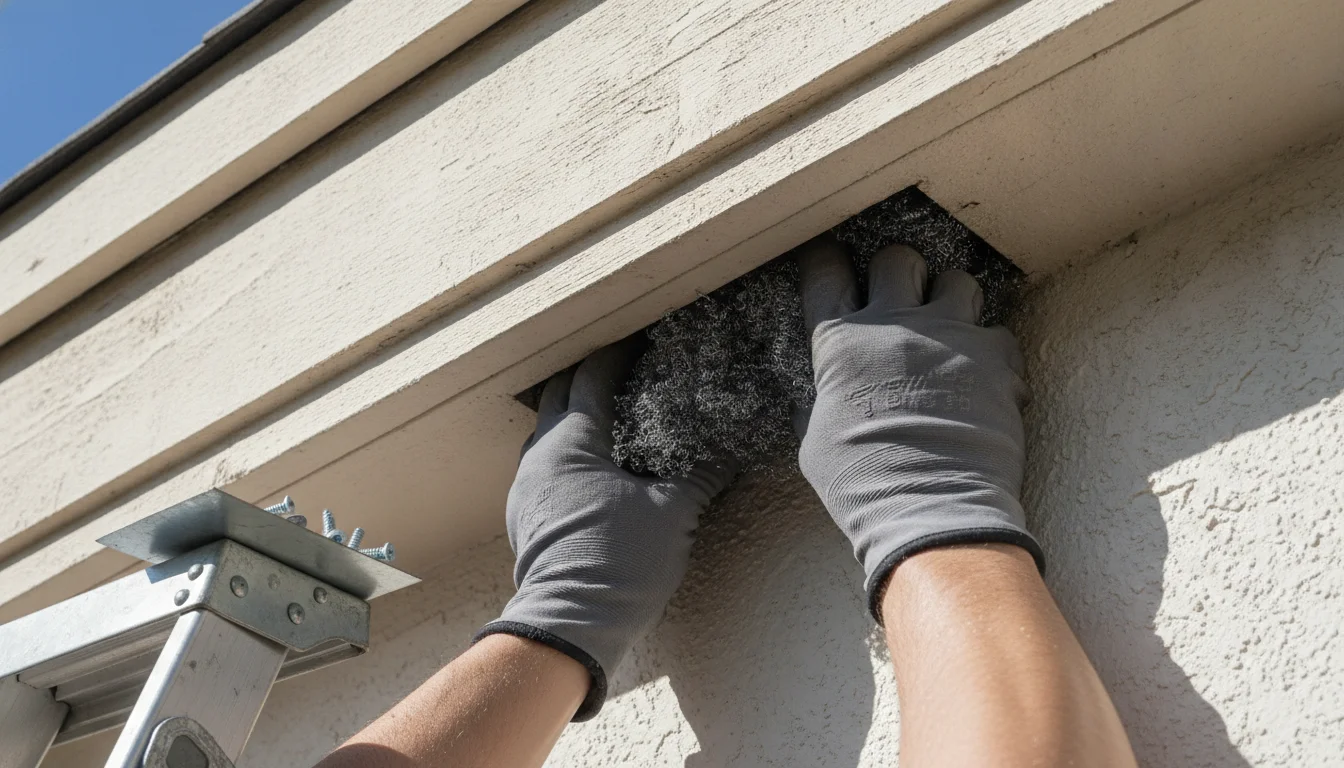
Leave no hole bigger than 1/2 inch (13 mm). If the head fits, the body follows, and they’ll chew soft material wider. Plug gaps with coarse steel wool, wire screen or sheet metal, and cover gnawed edges with sheet metal. Do the shed, the garage and the space under the deck too.
5. Fit a one-way door over the last gap
If you think one is still inside, don’t seal it in. Kansas State describes a simple fix: a temporary flap of sheet metal hinged at the top over the main entry. The animal pushes it open to get out but can’t push it back in. Once you’re sure it’s gone, seal that hole for good.
Avoid the breeding season if you can. Bushy-tailed woodrats breed from January to August, peaking March to June, and you don’t want young shut in.
6. Clear the nest wet
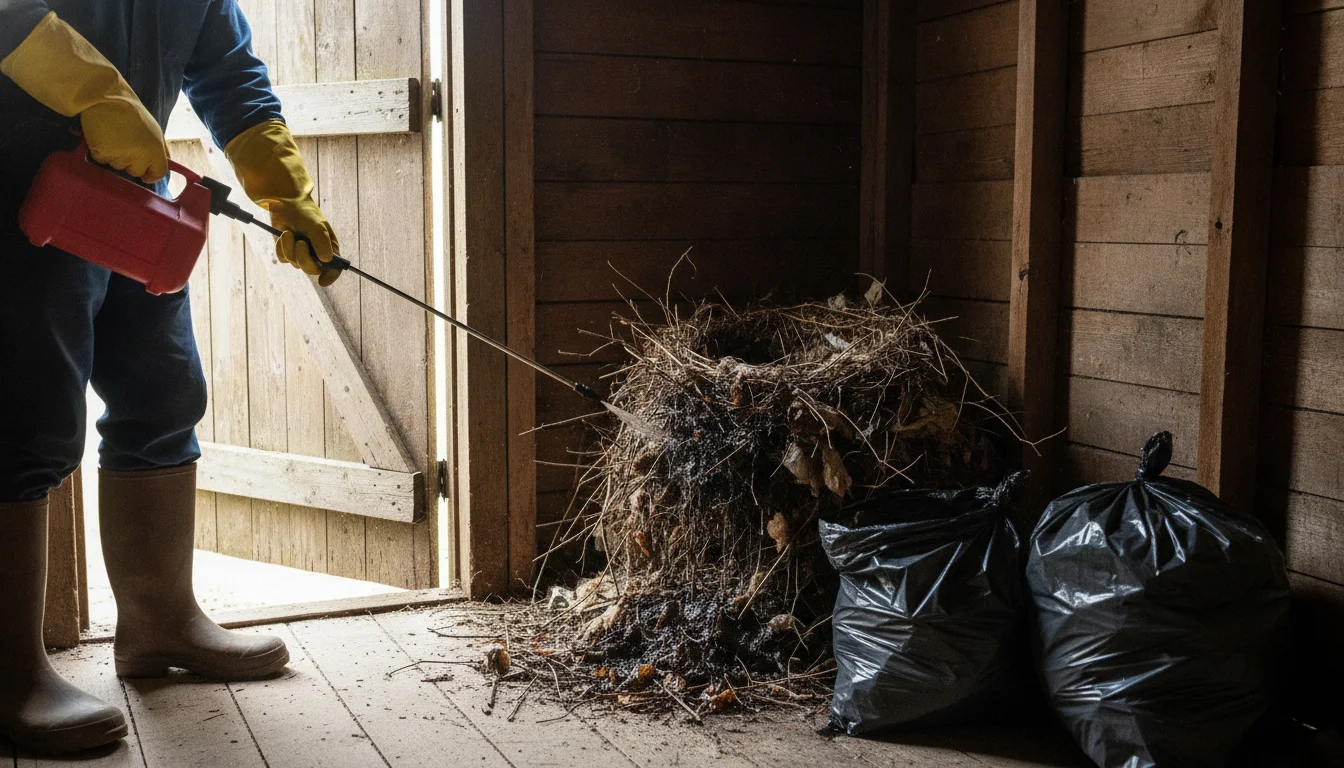
Once the animals are gone, the nest has to go too. Do it wet, never dry. Nest dust can carry viruses, and the Centers for Disease Control and Prevention says flatly not to sweep or vacuum rodent droppings, urine or nesting material. University of Arizona researchers add that these nests breed kissing bugs, which can crawl into a house from a nest built against it and bite.
The routine, from the CDC:
- In a shed, garage or attic, open the doors and windows and stay out for 30 minutes.
- Wear rubber or plastic gloves, and put insect repellent on your clothes and shoes (nests carry fleas).
- Mix 1.5 cups (355 ml) of household bleach into 1 gallon (3.8 L) of water, fresh, or use a product labeled as a disinfectant.
- Spray the nest and the area around it until soaked. Wait 5 minutes.
- Pull it apart a section at a time, wetting each new layer. Bag it, double-bag it, seal it and put it in a covered trash can.
Lost keys and jewelry do turn up in these nests. For a big nest in a closed building, step up to coveralls, goggles and a respirator with HEPA filters, or hand the job to a professional.
7. Take away the cover
Shelter is the draw, so take it away. Move woodpiles off the house and away from sheds, clear brush and junk piles, and trim branches that touch the roof (they climb). In the desert, check under cholla and prickly pear clumps, which they love for the spines. Keep sheds and garages organized.
8. Drive the car
Woodrats nest in the engine bays of cars that rarely move, and cold pushes them into abandoned vehicles, cabins and campers, where they chew wiring. Start and drive a stored car at least once a week, park it somewhere different when you can, and lift the hood to look. Found sticks and droppings in there? Clear them using the wet method above, with the engine cold. More on this in rodents in your car.
9. Protect the garden and pick up food
Food is a smaller pull for woodrats than for house rats, but gardens suffer. Arizona’s extension office fields calls about pansies nipped off every morning and ripe tomatoes carried off to odd spots. A smooth sheet metal barrier at least 2 ft (60 cm) tall protects a bed or a single plant. Pick up fallen fruit, bring pet food and birdseed in, and fix leaking irrigation.

10. Poison, last and outdoors only
Rodenticide works on woodrats, but they come with a twist: they haul bait back to the nest and stash it, sometimes without eating it for a while. Pellets are worst for this, which leaves poison where pets and other animals can find it. Colorado State also notes they stuff bait boxes with sticks. If you use it at all, keep it outdoors, in tamper-resistant stations, exactly as the label says, and never where a protected woodrat might live. Kansas State’s advice is that poison shouldn’t be your only method.
When to call a professional
Call a wildlife or pest professional when the nest is under the house, inside a wall or attic you can’t reach safely, or in a closed building heavily used for months. Do the same if the damage keeps coming after trapping and sealing, or if you might be in the range of an endangered woodrat. For heavily infested buildings the CDC suggests contacting your local or state health department.
How to get rid of pack rats: FAQ
Are pack rats dangerous?
Don’t handle one, alive or dead. Like any wild rodent, a woodrat can carry disease, and bites, scratches and direct contact can pass it on. You can’t tell a carrier by looking at it, so wear gloves even for a dead one. The bigger everyday risk is the nest. Disturbing dry droppings and nest material is how people breathe in rodent-borne viruses, and the nests harbor fleas, ticks and kissing bugs.
Do repellents, peppermint oil or ultrasonic devices work?
Not reliably. A wildlife damage handbook from the University of Nebraska says no repellents are registered or considered effective for woodrats.
Why is there a pile of sticks under my hood?
A woodrat has started a nest because the car sits still long enough to feel safe. Clear it wet, then drive more often.
Will they come back?
Yes, if the nest and the shelter stay. Kansas State advises destroying nearby nests after removal to cut down on new arrivals.