Table of Contents
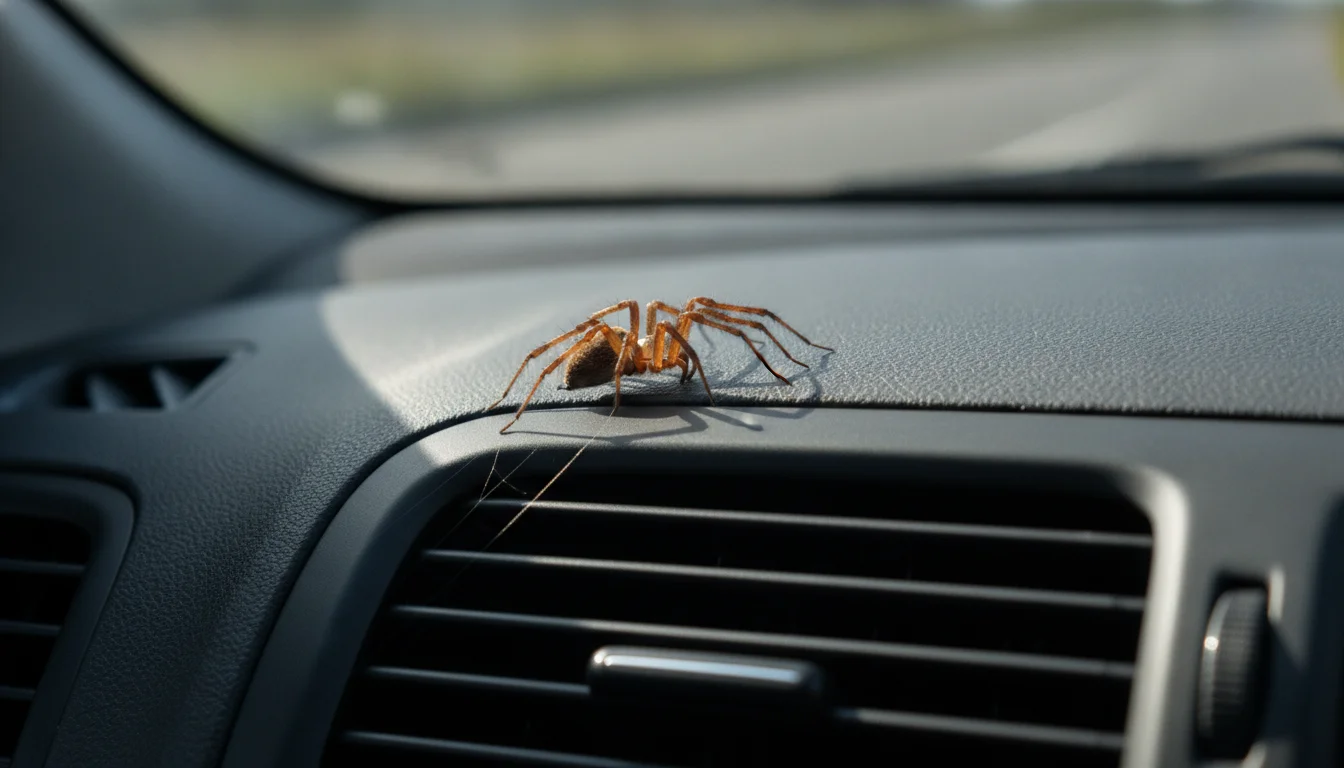
Working out how to get rid of spiders in car vents, mirrors and door seals starts with one rule: the spider on the steering wheel isn’t the dangerous part. The driver who lets go of the wheel to swat it is. Most spiders that end up in a car are harmless hitchhikers that wandered in through a window, a door seal or a bag, and they’re far more interested in a quiet gap behind the dashboard than in you.
So this starts where the problem usually starts: mid-drive, with a spider that just vanished into a vent. Then how to get it out once you’re parked, what to do when it’s gone behind the dash, where spiders get in, and why a bug bomb in a closed car is a bad idea.
What causes spiders in a car
A parked car is warm, dark, sheltered and, if it sits for a few days, completely undisturbed. That’s the whole appeal. Spiders get in through open windows and sunroofs, through small gaps at the window rails and along worn door seals, and in bags, boxes and gear that sat on the ground before you loaded them. One owner on a Mazda forum found two webs tucked into the upper rubber lining of the driver’s door. Parking under trees and hedges makes it far more likely, because the spiders are already living right there.
Once inside, they pick spots that don’t vibrate much: the headliner, the sun visors, the dashboard, the space behind the side mirror glass. And it isn’t only the cabin. In 2011 Mazda recalled 52,000 Mazda6 sedans (2009-2010 models) in the US because yellow sac spiders were spinning webs in the evaporative canister vent line, which could stress the fuel tank to the point of cracking. A second recall in 2014 covered 42,000 more (2010-2012, 2.5-liter). If you drive one, check the recall status on NHTSA’s site with your VIN.
1. Pull over before you do anything
Don’t swat it. Don’t look for it. Keep both hands on the wheel, don’t brake hard or swerve, and keep driving until there’s somewhere safe to stop. Then park, turn the engine off, and deal with it.
Road-safety guidance from RACV, the Victorian motoring club, says exactly this, and cites the state transport authority’s figure that taking your eyes off the road for two seconds or more doubles your crash risk. In 2019, police in Cairo, New York reported a driver who saw a spider in the driver’s area, panicked, hit a stone barrier, totaled the car and hurt her leg. A spider that just ran behind the dash isn’t going to get you in the next 60 seconds. You’ve got time to stop properly.
2. Park with the doors open and let it walk out
Once you’re stopped, open every door and give it a chance to leave on its own. Sun helps a lot: park in direct sunlight with the doors open, and the heat and light push spiders out of dark crevices. One pest control company puts it at 15 to 20 minutes.
Speed it up with a little disturbance. A Leeds zoologist interviewed about a spider living in a presenter’s car vent pointed out that spiders feel vibration rather than hear sound, and suggested gently disturbing the web to coax it out. Shake out the floor mats. Tap around the vent it went into.
3. Catch it under a jar
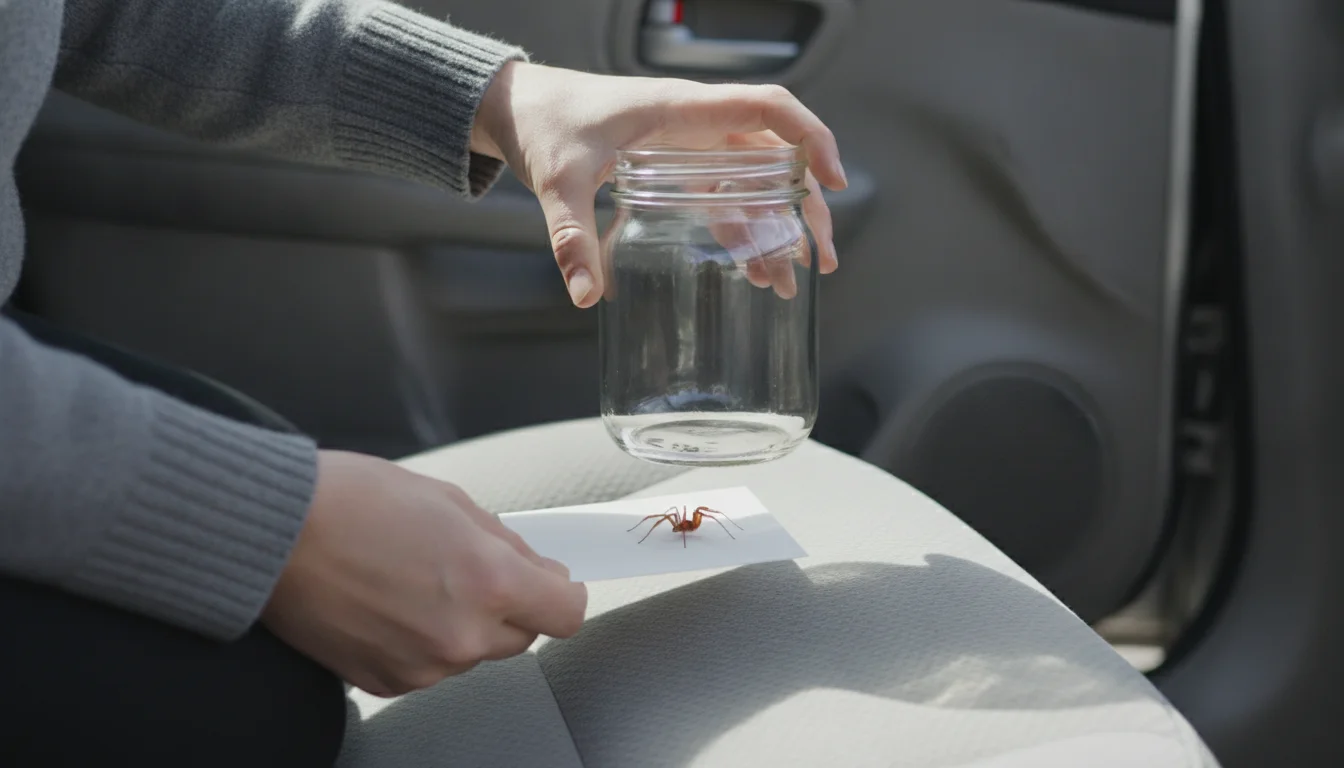
If you can see it, a clear jar and a stiff piece of card will get it out of the car without anyone touching it. Put the jar over the spider, slide the card slowly under the rim, lift both together, and tip it out well away from the car. Don’t grab it by hand: bites mostly happen when a spider is pressed against skin.
4. Run the fan on full to flush the vents
This is the one for the spider that ran into a vent or behind the dash. Doors open, engine on, heater or air conditioning fan to full, and cycle through every vent setting: face, feet and windshield. The airflow and vibration disturb anything sheltering in the ducting, and it often comes out of a louvre or drops into the footwell. Stand outside with the jar ready.
It doesn’t always work. One Reddit poster who tried to grab theirs watched it run straight back into the AC. If nothing comes out, it’s somewhere the air doesn’t reach.
5. Vacuum everything, then empty it outside
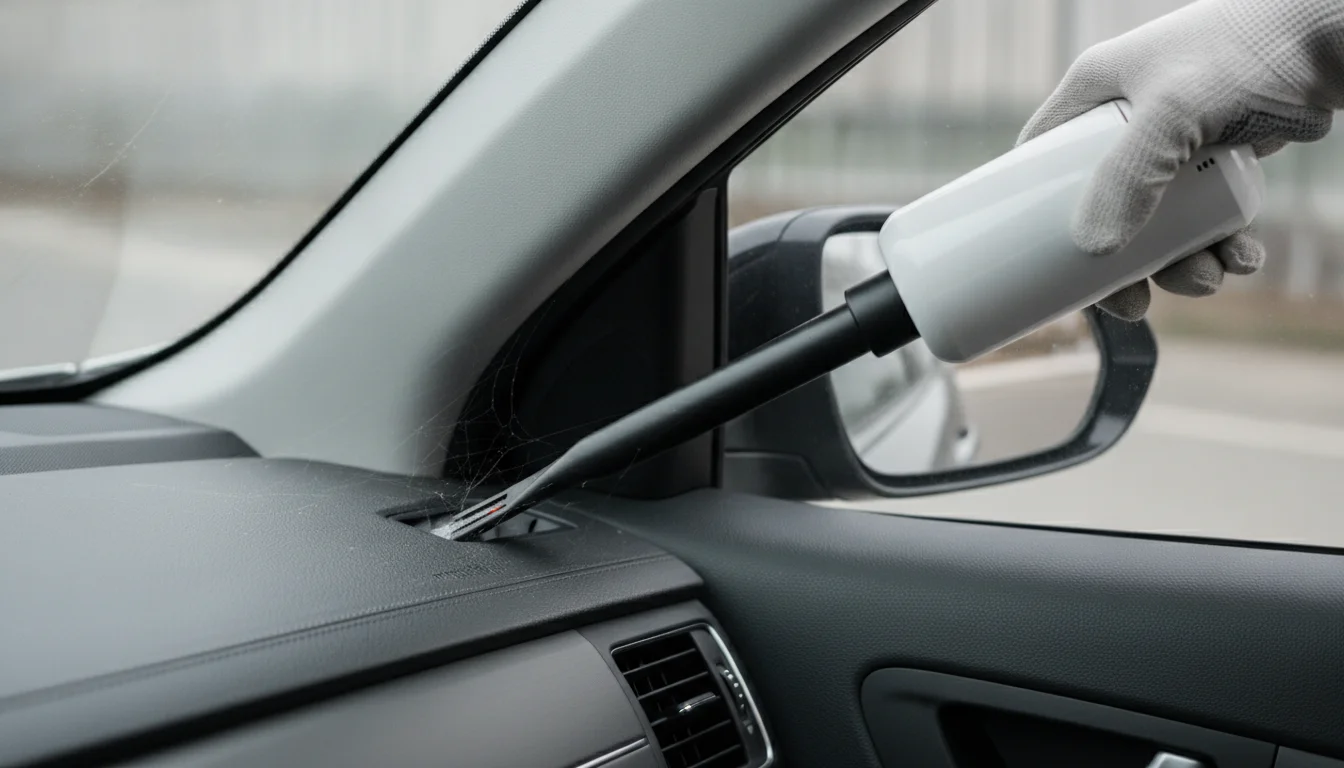
A vacuum takes the spider, the web and any egg sac in one pass, and the soft-bodied ones rarely survive the trip. Use the crevice tool under and between the seats, along the seat rails, in the door pockets, around the vent louvres, along the headliner edges and behind the sun visors. Empty the canister or bag outside straight away and seal the contents in a plastic bag, so nothing crawls back out.
This is the closest you’ll get to “making sure it’s dead.” You often can’t be sure about one deep behind the dashboard. Vacuum, watch for fresh webs over the next few days, and repeat if you see any.
6. Flush out the side mirror housing
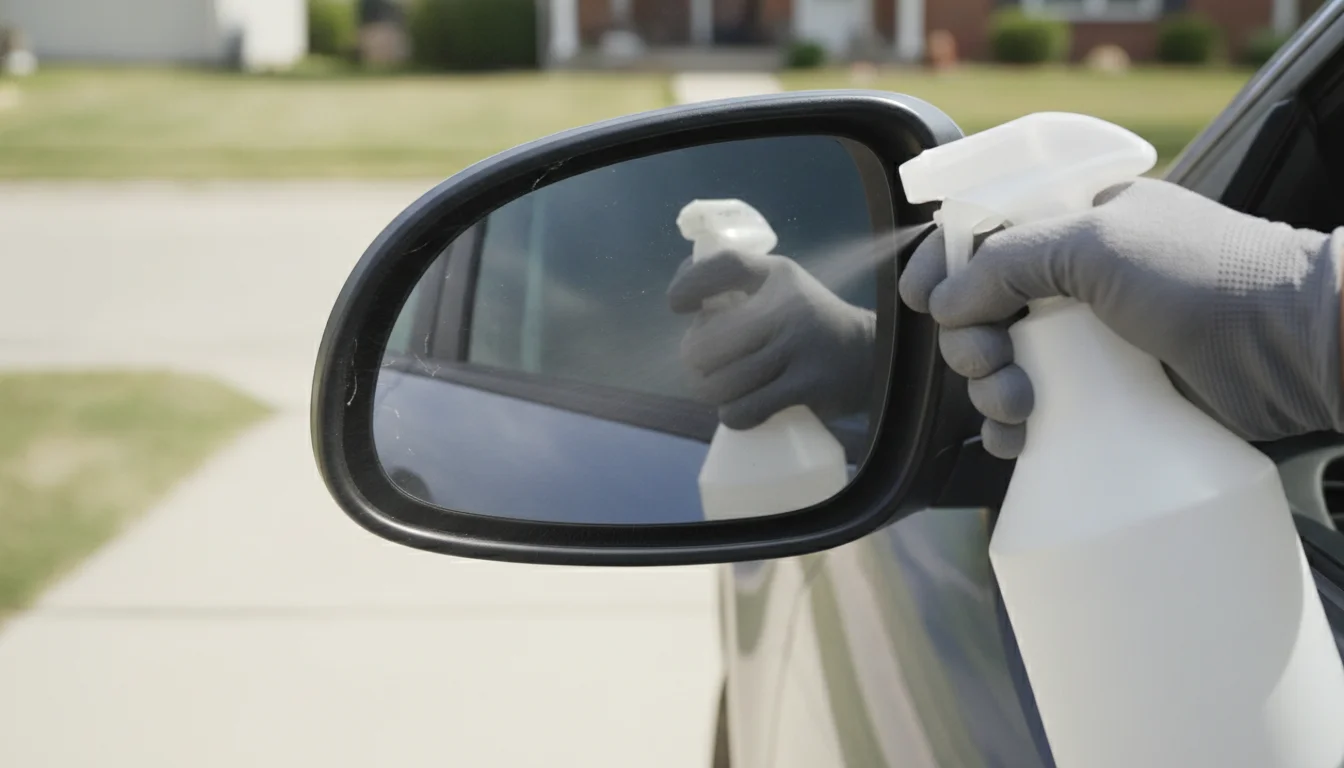
Webs all over the side mirror every morning? There’s probably a spider living behind the glass, where the housing keeps it out of the wind. A hose won’t shift it. One owner who kept getting spiders from the palm trees by the driveway found that angling the mirror fully in toward the car (power controls or by hand) opened the gap, and spraying household glass cleaner generously into the space brought the spider out almost immediately. Wipe out the webs, then rinse the housing well with water so the cleaner doesn’t streak the paint. No need to take the glass off.
While you’re out there, brush or hose webs out of the wheel arches and grille, and clear twigs and leaves from under the hood.
7. Check the cabin air filter and its housing
The fresh air for your heater comes in through an intake, usually under the cowl at the base of the windshield, and passes through the cabin air filter, which on many cars sits behind the glovebox. Your owner’s manual shows where. Pull it and look at the filter and the housing for webs, silk or spiders. One Mazda owner’s dealer checked the filter and found spider “strings” in it. If the filter is missing, damaged or long overdue, fit a new one the same way round as the old one.
To be fair about it: this is a check, not a guaranteed fix. A Subaru owner on a detailing forum removed and cleaned the filter, sprayed under the dash, and still had spiders showing up on the dash and vents. Plenty come in through doors and windows.
8. Fix the door seals
Run your fingers along the rubber seals on every door and the trunk. Look for cracks, sections pulled away from the frame, and webs tucked into the seal itself. A torn or flattened seal is a gap, and a door that doesn’t fully close (one Reddit poster had an inch-wide gap after an attempted break-in) is an open invitation. Have your mechanic check the door seals at the next service if you’re not sure.
9. Get the trash and crumbs out
Spiders don’t eat your fries, but the insects they eat do. Clear out food, wrappers, cans, bags and the clutter that lives in the footwells, and empty the cup holders, door pockets, console and trunk. Less clutter also means fewer places to hide.
10. Park somewhere else
If you park under a tree, against a hedge or next to the same bush every night, the spiders are walking across from it. Move the car.
11. Try a peppermint spray as a deterrent
Peppermint is a popular spider deterrent, but it’s a deterrent at best, and the evidence is thin, so don’t expect it to clear a spider that’s already moved in. If you buy a peppermint repellent, check that its label allows use inside a vehicle, and use it only where and how the label says. A car cabin is a small, closed space, so skip homemade mixes and keep any spray out of the vents. Peppermint oil is toxic to cats, so skip it if one rides with you.
12. Call a professional for a real infestation
One spider is a visitor. Egg sacs, several spiders, or fresh webs every day mean they’re living in the car, and that’s when a professional earns their fee. More on that below.
How to prevent spiders in a car
Shut the windows and sunroof every time you park, keep the seals in good shape, park away from trees and bushes, and keep the cabin empty. Check bags, boxes, plants and secondhand parts before they go in: one Reddit poster who installed a used interior in an old Integra had black widows all through the car within days. Drive the car regularly, because a car that sits for weeks is the quiet, undisturbed shelter spiders are looking for.
When to call a professional
Call a pest control company when you find egg sacs, see webs come back daily, keep finding spiders after working through the steps above, or think you’ve got a black widow or brown recluse in the car. Same if kids or pets ride in it and you don’t want to use chemicals yourself. Pest firms that treat vehicles inspect the vents, seat rails and dash cavities, and some use CO2 snow treatments that leave no residue. One company quotes $100 to $300 for a one-time treatment.
What not to do is set off a bug bomb. In a car, the fog coats the dashboard, glass and seats with an oily residue and doesn’t get into the vents, door panels and dash cavities where spiders shelter. Many foggers use flammable propellant, the residue can work its way into electronics, and the cabin needs a long airing-out before anyone sits in it. Same story as roaches in a car: a pro with targeted treatments beats a fogger every time. And don’t put any pesticide into the vents unless its label expressly allows that use. Whatever product you use, follow the label.
FAQ
Will a spider in my car die on its own?
Possibly, but don’t count on it soon. A car with insects to eat and places to hide can keep a spider alive for months, and one r/MechanicAdvice poster had a spider living in a passenger mirror for about six months. Flush it out rather than wait.
Can spiders lay eggs in a car?
Yes. Behind the dashboard, inside door panels and vents, and under floor mats and trunk linings are all candidates. One pest control company says spider eggs can hatch in 2 to 4 weeks, so vacuum and bag any sac you find right away, and call a professional if you find more than one.
Are spiders in a car dangerous?
The spider usually isn’t. Most of the ones you’ll find in a car are unlikely to bite unless they’re pressed or trapped. The real danger is a startled driver taking their hands off the wheel.
Can I use a bug bomb in my car?
No. It misses the places spiders hide, leaves residue on the cabin and electronics, and many use flammable propellant.
I keep finding spiders. Is my car infested?
One spider now and then is a hitchhiker. Several, webs reappearing daily, or egg sacs mean they’re breeding in the car. Work through the steps above and call a professional if it continues.