Table of Contents
The spent cylinder from your grill or camp stove is the one thing in your trash that can injure the person who empties it. A propane cylinder is a pressure vessel holding flammable gas, so a truck or a sorting plant that crushes it can set off a fire that reaches the crew. So the default is simple: keep it out of the trash and never in curbside recycling, whatever it weighs. The one exception is a confirmed-empty one-pound disposable canister where your local waste authority expressly allows it in the trash and tells you how to prepare it. The safe path is short and free or nearly free, and it splits by what you hold: a 20-pound barbecue tank has different exits from a small one-pound camping canister. Here is how to get rid of propane cylinders the right way, one route per type, starting with the two things you must never do.
1. Keep it out of the trash and curbside recycling
Rule out the route most people reach for first. As a default, a propane cylinder does not belong in the trash or the curbside recycling bin, canister or grill tank, full or empty. Two facts make it dangerous to waste crews: it is still under pressure, since a cylinder you think is spent often holds a residual charge, and propane is flammable. Inside the crushing jaws of a garbage truck or the shredders of a sorting plant, it can split open and release gas into an environment full of sparks, which is why many sanitation services will not collect propane tanks in the trash. There is one narrow exception: some local waste authorities allow a confirmed-empty one-pound disposable canister in the household trash after specific preparation, so check your own program’s rule before you assume either way. That exception never extends to curbside recycling or to any larger tank; the recycling bin feeds the same fast machinery, and recyclers want the steel only through a channel that manages the pressure and gas first. While a cylinder waits, store it outside, upright, valve closed and cap on, out of sun and heat, and mark it so no one throws it out by mistake.
2. Never puncture, crush or burn it
The other tempting shortcut is to make the cylinder “safe” yourself: pierce it to release the pressure, squash it flat, or throw it on a fire to be rid of it. Do none of these. A puncture, a crush or a flame can rupture a pressurized cylinder and ignite the gas that escapes, so do not drive a nail or drill into it, put it in a compactor, or toss it in a fire pit or burn barrel where the heat alone will make it burst. Depressurizing is a real disposal step, but only with purpose-built equipment operated by a business, scrap recycler or hazardous-waste facility, never by hand at home. Camp forums are full of people trying to wrench the valve off an old tank with a four-foot cheater bar and welded-on angle iron; the effort and the risk are proof that this is not a home job. The same rule holds for any pressurized container, from aerosol cans to a camp canister: keep it whole and pass it on intact.
3. Swap a 20-pound grill tank at an exchange cage
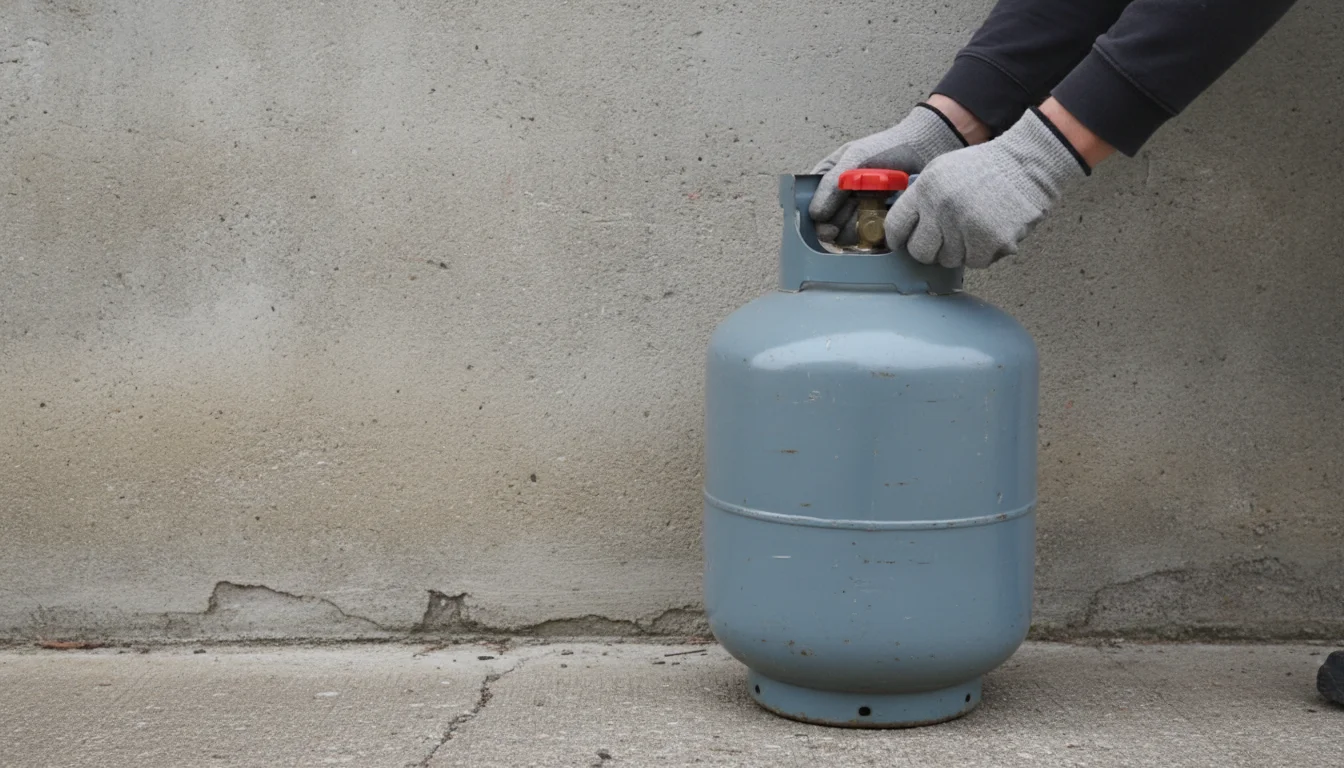
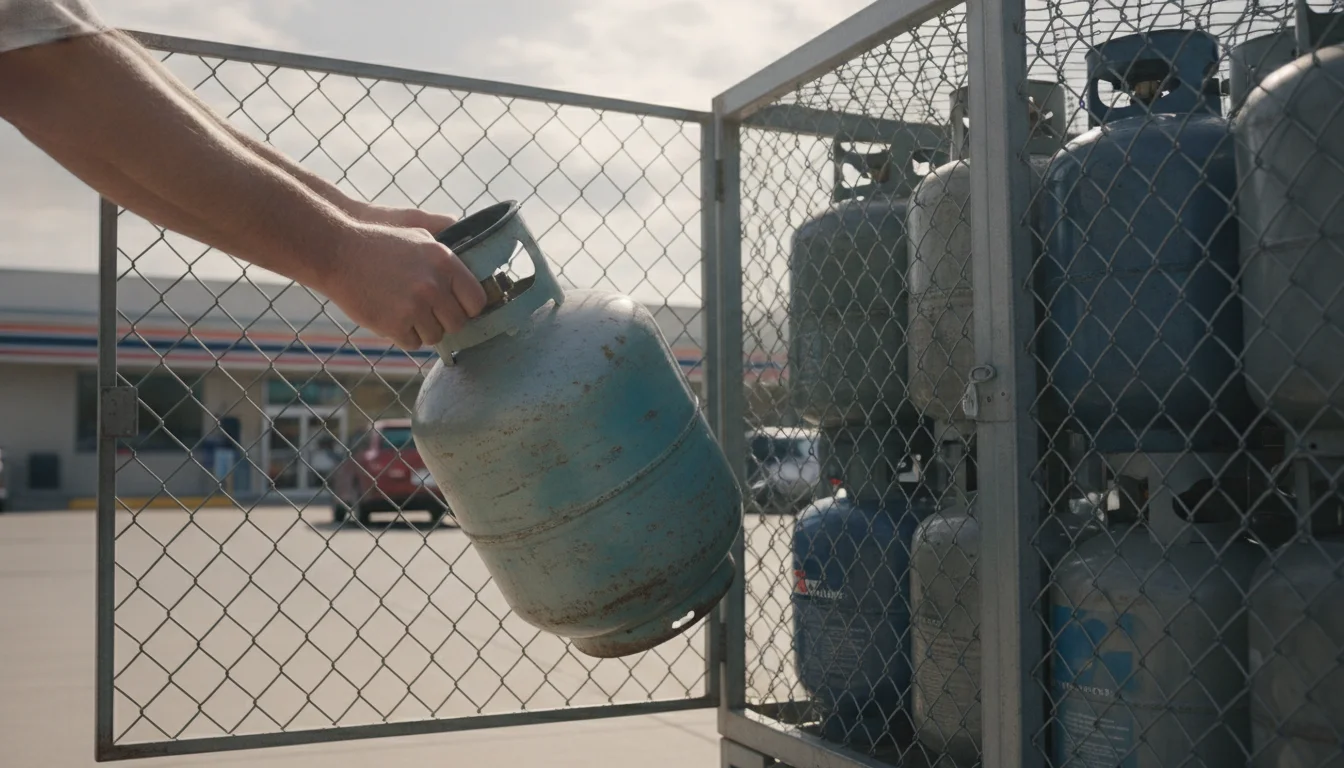
For a standard 20-pound barbecue tank, the easiest exit is the exchange cage outside supermarkets, hardware stores and home centers. You hand over your empty, pay for a full one, and the old tank becomes the network’s problem; even a tank that is out of date or no longer fills is accepted, because the exchange company requalifies or retires it in its own facilities. If you are done grilling for good, many locations will take the empty even when you are not buying a replacement, often free, so ask at the counter rather than leaving it beside the cage. Know the trade-off: an exchange tank is typically filled to about 15 pounds of propane rather than the roughly 20 a grill tank holds, at a fixed price, so it costs more per pound than a refill. Bring the right cylinder, too. Cages take standard 20-pound tanks and may turn away a rusted or leaking one, and a small camping canister does not belong in a grill-tank cage at all.
4. Take a grill tank to a propane dealer
A private propane dealer, or a hardware store with a refill station, is the route for a 20-pound tank you want kept in service, or one you cannot judge. A refill fills your own tank to its rated capacity and prices it by weight, which usually beats the fixed swap price; before filling, staff check the tank’s condition and its date, because a grill tank must be requalified periodically to stay legal to fill. If yours is expired, a dealer can requalify it or tell you it is finished, so you leave with a clear answer instead of a guess. That inspection is why a dealer suits a tank you are unsure about: a rusted, dented or long-expired one that an exchange cage might turn away can be assessed by someone who handles propane daily, and some dealers will also take an end-of-life tank for disposal or recycling. Whether a given dealer does depends on the dealer, so call first and ask both whether they refill customer-owned tanks and whether they will take one purely for disposal, since not every hardware store with a grill display runs a refill station.
5. Never refill a single-use camping canister
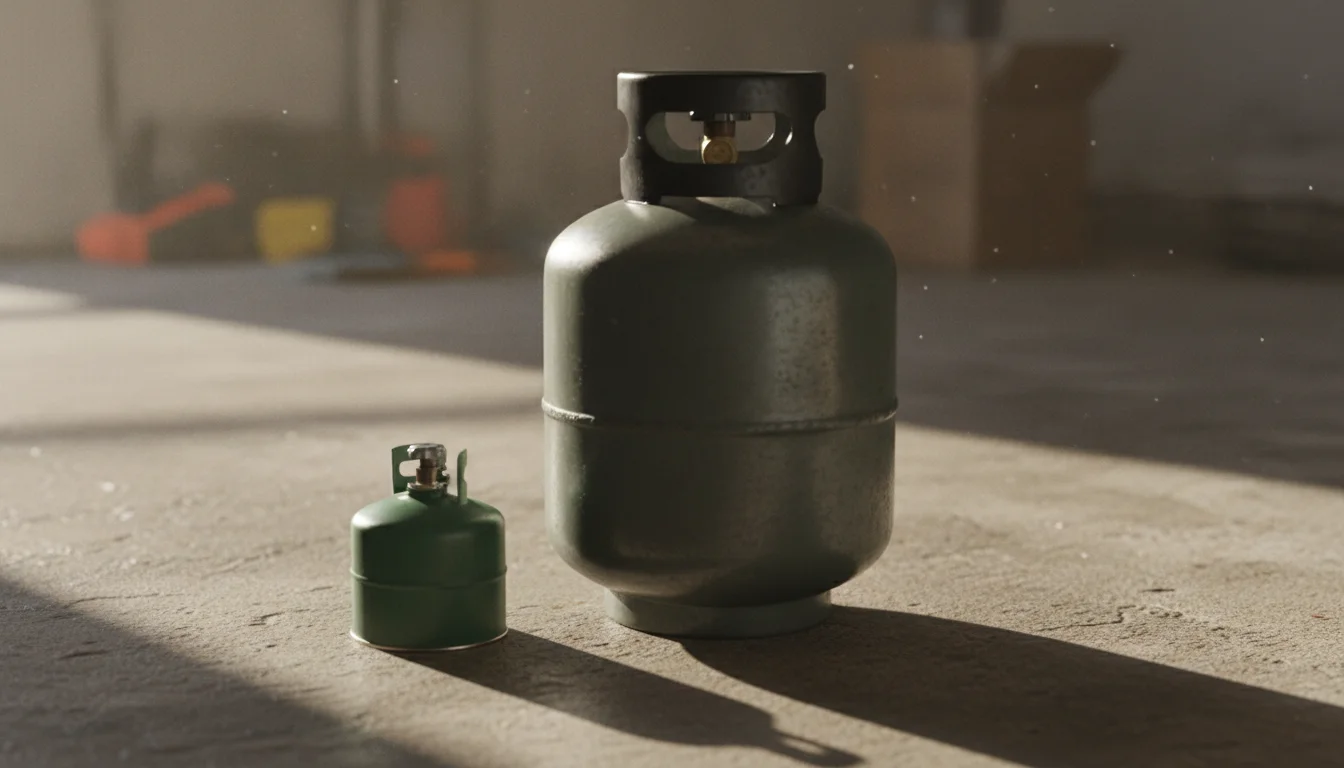
The small green one-pound canister that powers camp stoves and lanterns is made to be used once. Do not refill it, and do not let a video convince you it is a clever hack. These are DOT-39 cylinders, certified for a single factory fill and not built to be refilled. Federal law forbids transporting one of these cylinders on the road if it has been refilled, and PHMSA cautions the public not to refill them at all, pointing to documented incidents from the practice. The refill hacks online promise a cheap workaround that the safety rules do not support, and people who follow them can end up with a cylinder that leaks or fails. Read the label to tell the two kinds apart: “disposable,” “non-refillable” or “single use” means one fill only, while a refillable bottle is marked as reusable and is the only kind legal and safe to fill again. For the disposable canister in your hands, the ending is disposal, not a refill adapter.
6. Take any cylinder to household hazardous waste
When no exchange cage or dealer will take a cylinder, a household hazardous waste (HHW) program is usually the route that will, and it is the safe default for any cylinder that is not empty. Many county and municipal HHW depots and periodic collection events accept the small one-pound canisters and the larger grill tanks, often free for residents; these are the same programs that take old gasoline and leftover oil-based paint. Acceptance is not universal, so check your local program first: some sites cap the tank size they take, often around the five-gallon grill-tank range, some take one-pound canisters but not full tanks, and a few charge for larger tanks. If your program will not take a particular cylinder, route it to an accepting supplier, exchange operator or other local authority instead. A program that does accept it manages the pressure and the gas with the proper equipment, which is exactly the work you must not attempt at home. Confirming your local rule is a five-minute job: enter your ZIP code in a recycling locator such as Earth911, call a line like 1-800-CLEANUP, or open your city or county solid-waste page and look for propane or pressurized cylinders. That tells you the nearest site, its hours, any size limit and whether a fee applies. Carry the cylinder upright and secured, valve closed, in a ventilated part of the vehicle, and never leave it in a hot, closed car.
Propane cylinder disposal FAQ
How do I dispose of a 1-pound propane canister near me?
Take it to a household hazardous waste depot or collection event that accepts one-pound cylinders, or to an outdoor retailer that runs a take-back drive for them. Use a recycling locator such as Earth911 with your ZIP code to find the nearest site. Never refill a disposable one, and keep it out of curbside recycling.
Is propane cylinder disposal free?
Often, but not always. Many HHW programs take cylinders free for residents, and some exchange cages and dealers accept a tank for recycling at no charge. Larger tanks or non-resident drop-offs sometimes carry a fee, so confirm on your county solid-waste page or by calling ahead.
Can I ever put a propane cylinder in the trash?
Usually not, and only in one narrow case. A cylinder that feels empty can still hold pressure and gas, so a 20-pound tank never goes in the trash and no cylinder goes in curbside recycling. The single exception is a confirmed-empty one-pound disposable canister where your local waste authority expressly allows it and gives the preparation steps; many programs do not. When in doubt, route the cylinder through a return, dealer or hazardous-waste channel instead.