Table of Contents
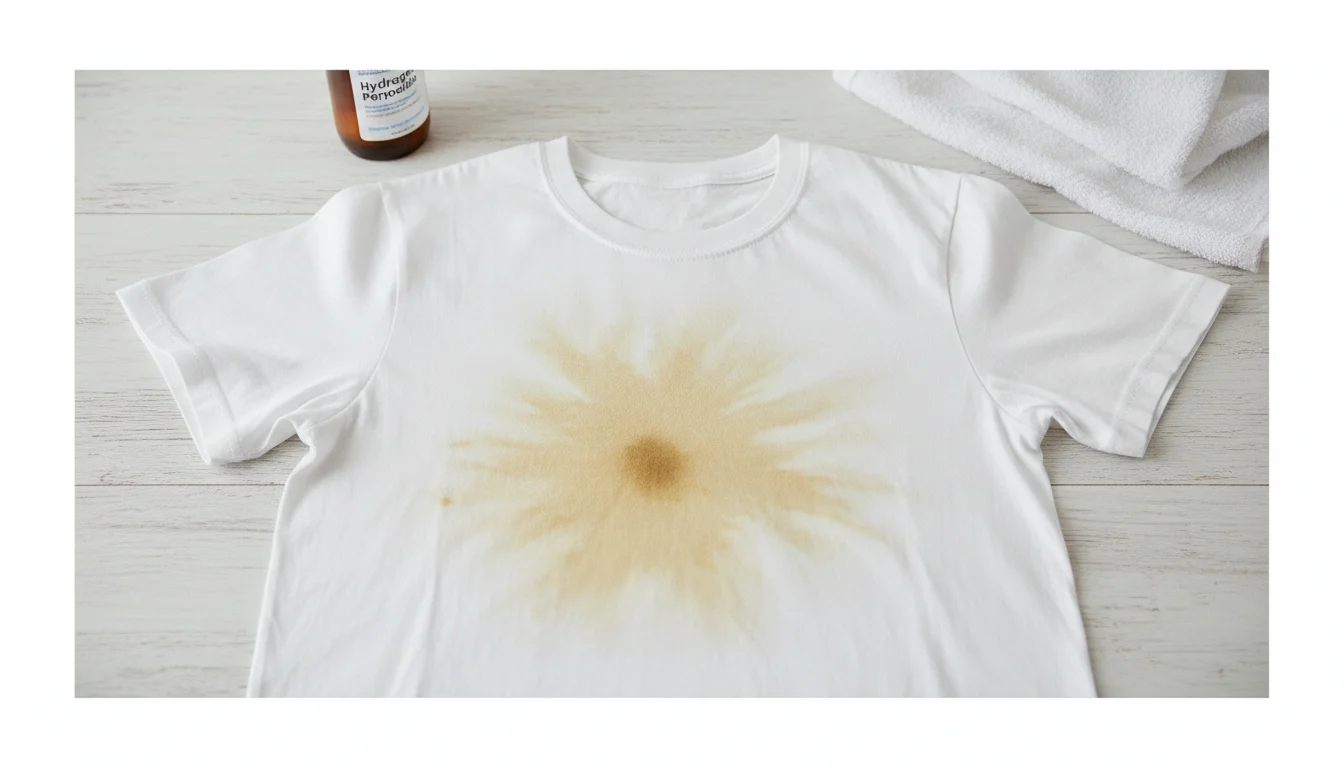
Yellow bleach stains are the confusing case: you bleached a white shirt to brighten it and it came out yellow instead. Whether the yellow comes out depends entirely on what caused it, and two very different causes look identical.
If the bleach itself damaged the fabric – too much, undiluted, or used on a fabric that cannot take it – the yellow is permanent. The chlorine has altered the fiber, and nothing washes that back out. Dryer heat locks it in for good.
But a lot of what people call bleach yellowing is not fiber damage at all. Iron in the water reacts with chlorine to leave a rusty yellow deposit. General oxidation and age dull whites to yellow over time. Those two lift, because the fiber is intact – the yellow is a deposit sitting on it, not lost structure. Un-rinsed chlorine is a third case, and a different one: bleach that never fully rinsed out keeps sitting in the fabric and reacting, so neutralize it fast to stop further damage, but any yellow it has already produced is set for good, the same as any other bleach damage.
So the first job is to work out which one you have. If you catch it fresh, neutralize any leftover chlorine before it does more, then lift what is a removable deposit. A pale or white patch where the color is simply gone is neither: that is dye loss, a different job covered in permanent bleach stains. For a white-cotton, fabric-by-fabric walkthrough, see yellow bleach stains from white clothes.
One case this page does not cover: hard surfaces. A yellow cast on a laminate countertop, a toilet seat or a sink is not a washable deposit you can soak out – it sits in the material itself, and what shifts it depends on what the surface is made of, not on any of the fabric soaks below. That is a separate job: see permanent bleach stains for the by-surface routes.
What Causes Yellow Bleach Stains
Too much or undiluted bleach is the usual culprit: it overwhelms the fabric instead of whitening it. Iron in the water supply is the other common one, reacting with chlorine to deposit a rusty yellow on the fabric. Bleaching a fabric that is not bleach-safe does it too – the chlorine damages the fiber rather than cleaning it.
There is also chlorine that simply never rinsed out. A water rinse alone does not clear all the trace bleach, so it stays in the fabric and keeps working, which is why fresh yellowing can deepen after the wash is done.
1. Hydrogen Peroxide Rinse
The move the moment you notice a white item yellowing after a bleach wash. It will not undo damage already done, but it stops leftover chlorine from doing more. Mix 1 part 3% hydrogen peroxide (the brown drugstore bottle) with 10 parts water and soak the item in it. That halts the bleaching action of any hypochlorite still in the fabric. Wash normally after.
Dollar-store peroxide works exactly like the pharmacy version, so do not pay for “premium”.
2. Oxygen Bleach Soak
This is the one that lifts removable yellowing – the general oxidation and dinginess that build up on whites. Oxygen bleach (OxiClean and similar) is sodium percarbonate, which releases hydrogen peroxide in water. Dissolve it at the label’s dilution in warm water and soak washable items 1 to 6 hours, then wash normally.
Iron is a separate case. If your water is high in iron and you want to keep bleaching whites, switch your default to oxygen bleach: it is not strong enough to convert iron to rust, so it whitens without the reaction that chlorine sets off. But it will not lift a rusty deposit that is already there. Chlorine bleach makes an existing rust stain worse, so for that you need a rust remover, a strong acid sold at hardware stores. Follow the product label and wear heavy-duty rubber gloves. Test a hidden spot for colorfastness first, dampen the mark, apply the remover until it clears, then rinse and wash. Vinegar and lemon are too weak to do it.
3. Sodium Thiosulfate Dechlorination
The dedicated dechlorinator, and the surest way to kill residual chlorine outright. Sodium thiosulfate (sold as Bleach Stop, and used in darkrooms and aquariums) neutralizes the residual bleach and stops its bleaching action outright, rather than masking it. Dissolve 1 ounce (28 g) in a gallon (3.8 L) of warm water, work the fabric in it for about 15 minutes, then rinse and wash normally.
A plain water rinse leaves trace bleach behind, so this dedicated bath is worth it when the yellowing keeps creeping back. Find it at aquarium or photo suppliers for almost nothing.
4. Baking Soda and Hydrogen Peroxide Paste
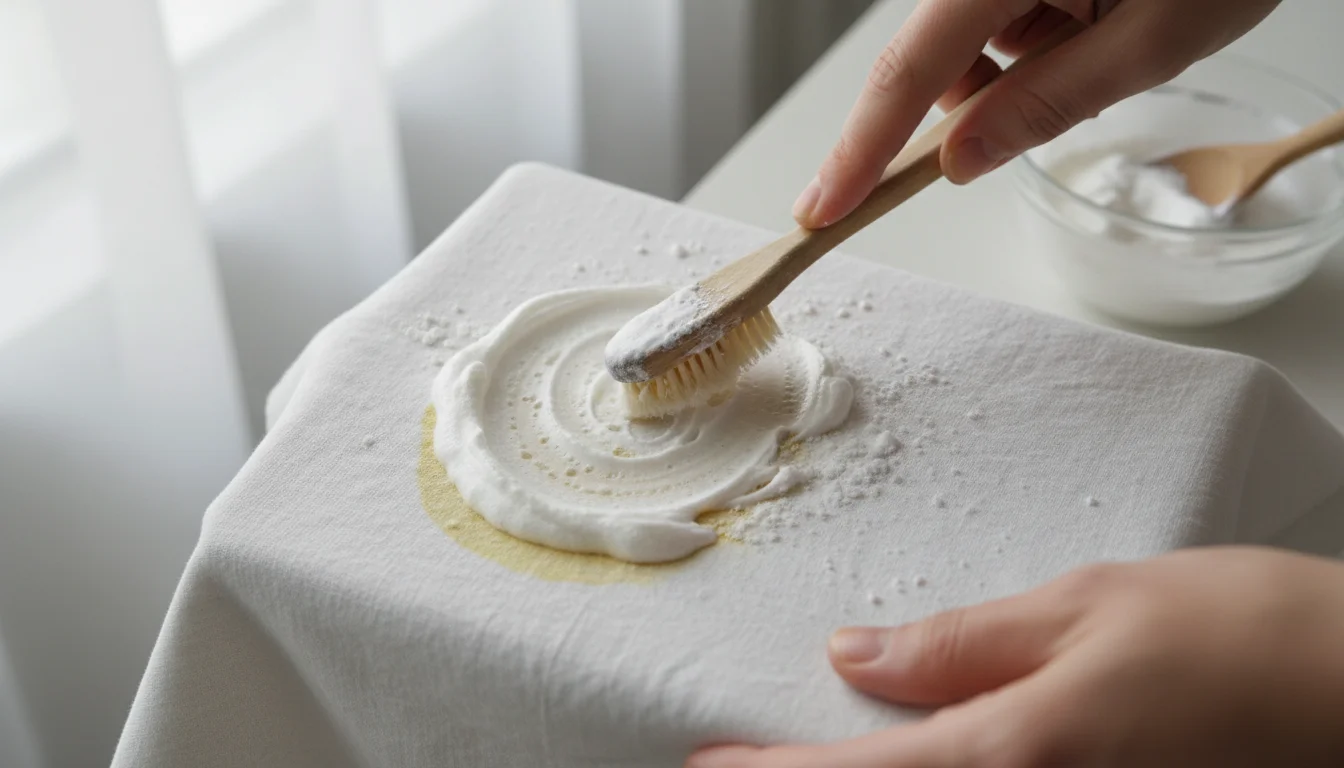
The spot treatment for a concentrated patch of removable yellowing a full soak has not shifted, using the same peroxide chemistry as method 1 in a form that stays put. Mix 2 tablespoons (30 g) of baking soda with enough 3% hydrogen peroxide to make a thick paste. Spread it on the yellow, leave it 30 minutes, then scrub lightly with an old toothbrush. Rinse cold and wash normally. The baking soda adds gentle abrasion while the peroxide does the chemistry.
It will not touch permanent bleach damage. If two tries do nothing, the yellow is in the fiber, not on it.
5. Bluing in the Rinse
Not a fix, a visual trick, and the honest fallback when the yellow will not lift: bleach damage, a fabric that was never bleach-safe, or yellow heat-set in the dryer. Bluing deposits a microscopic amount of blue dye that optically cancels yellow tones. Mrs. Stewart’s Bluing is the standard brand, and the dose depends on how you wash. For a top-loader rinse, dilute less than 1/8 teaspoon in a 2-quart (about 2 L) or gallon (3.8 L) container of cold water, then add it to the rinse. If you are washing by hand, a few drops in at least a quart (about 1 L) of cold water is enough. Never pour it straight onto the fabric, or you trade yellow for blue.
The yellow is still there. It just stops reading as yellow. For a fiber that cannot be un-yellowed, that is a legitimate result.
Prevention
Dilute bleach properly, every time, and follow the label on your bottle. As a guide, Clorox calls for 1/3 cup in a regular standard-washer load and 2/3 cup for an extra-large or heavily soiled one; in a high-efficiency washer, fill the dispenser to the max line. If you presoak, use 1/4 cup per gallon (3.8 L) of cool water and keep it to five minutes.
Only bleach fabrics that can take it. Cotton, polyester, nylon and acrylic are bleach-safe; wool, silk, mohair, leather and spandex are not, and bleach will damage them rather than whiten them. And if your water is high in iron, switch your default to oxygen bleach, which whitens without the chlorine-and-iron reaction that leaves the rusty yellow.
Frequently Asked Questions
Are yellow bleach stains permanent?
It depends on the cause, and that is the whole game. If the bleach itself damaged the fabric – too much, undiluted, or on a fabric that cannot take it – the yellow is permanent, and dryer heat locks it in. What lifts is yellowing that is not fiber damage: general oxidation and dinginess, which oxygen bleach handles, and a rusty deposit from iron in the water, which needs a rust remover. Un-rinsed chlorine sits in between: neutralize it fast and you stop it doing more, but any yellow it has already set stays. For the permanent cases, bluing (method 5) is the honest option.
Why does bleach turn white clothes yellow?
Usually too much or undiluted bleach, which overwhelms the fabric instead of whitening it. Iron in the water supply is the other common cause: it reacts with chlorine to deposit a rusty yellow. Bleaching a fabric that is not bleach-safe, such as silk, wool or spandex, damages it the same way.
Can you reverse yellow bleach stains?
Only when the yellow is a removable deposit, not fiber damage. Oxidation and dinginess respond to oxygen bleach; a rusty iron deposit needs a rust remover. Un-rinsed chlorine is a special case: a hydrogen peroxide rinse or sodium thiosulfate stops it doing further damage, but it does not reverse the yellow already there. True bleach damage – and any yellow you heat-set in the dryer – does not reverse. A pale or white patch where the color is simply gone is dye loss, not a stain, and it is permanent: on colored items see bleach stains from colored clothes.