Table of Contents
Spider mites are almost invisible until they aren’t. By the time you see the webbing and the stippled, yellowing leaves, the colony is already large. They reproduce fast – a female can lay 100 eggs in two weeks – and they thrive in exactly the conditions most houseplants and dry summers produce: warm temperatures, low humidity, stressed plants. The good news is that they’re not invincible. The bad news is that treating them once isn’t enough. This is a multi-week problem.
Detection and assessment
You can’t treat what you haven’t confirmed, and spider mite damage gets misdiagnosed regularly. Yellow stippling on leaves is the classic sign, but it can also mean nutrient deficiency or other pests.
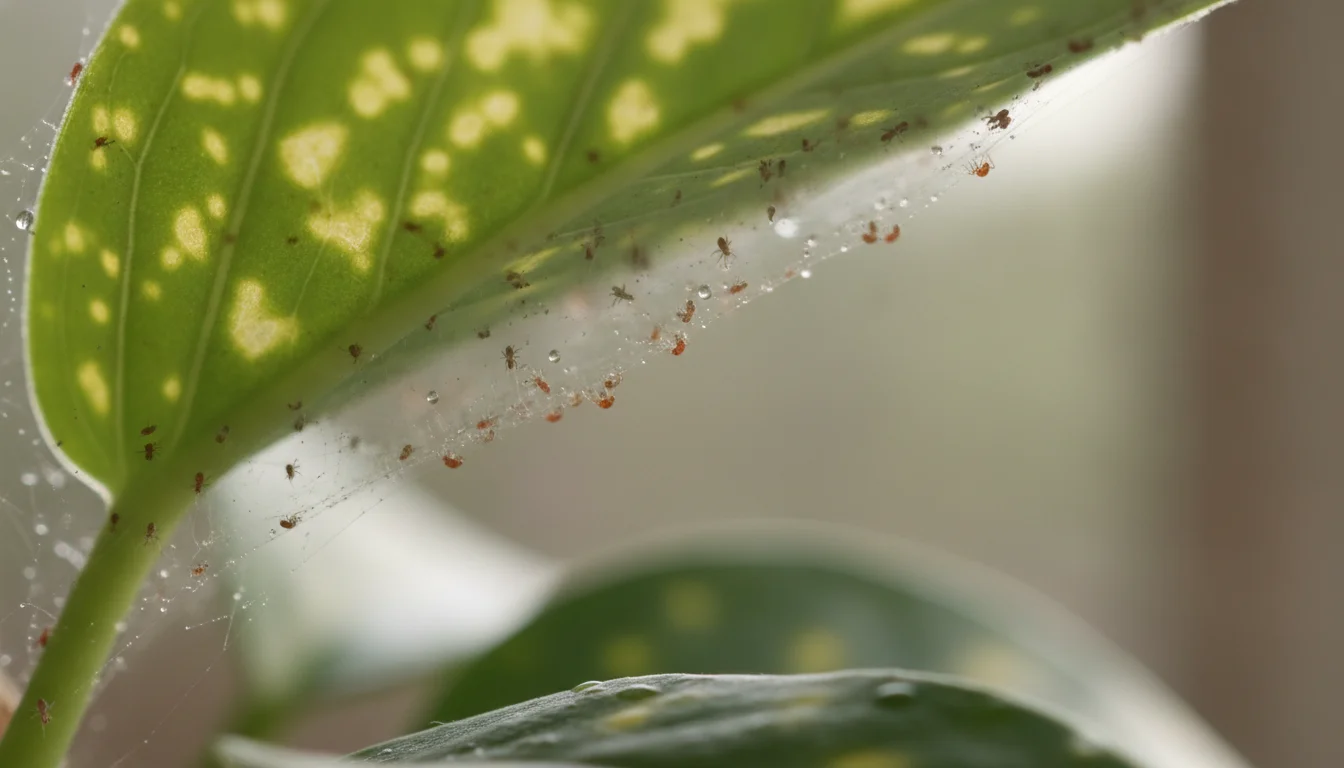
Watching for yellow stippled leaves gives you the visual checklist: the stippling appears on the upper leaf surface because mites feed from below, puncturing individual cells. Run your hand under a leaf – if it comes away with fine dust and tiny moving dots, you have mites.
Inspecting with a magnifying glass confirms it. 10x magnification is enough to see adults and eggs clearly. Check the undersides of new growth first – that’s where infestations start before spreading outward.
Isolation and physical removal
The first thing you do with a confirmed infestation is contain it. Every day you delay quarantine is another day the mites move to adjacent plants.
Quarantine the plant immediately. Move it away from other plants – across the room at minimum, another room if possible. Mites don’t fly but they transfer on hands, tools, and airflow.
Blasting with water is underrated. A strong spray from a hose or showerhead physically dislodges mites and their eggs. Not a one-time fix – mites that land on nearby soil can climb back up – but effective at reducing populations fast and making other treatments work better.
Removing heavily infested leaves reduces the reservoir. Bag them immediately; don’t compost. If a plant is more than 50% affected, treatments probably won’t save it.
Tossing the plant if treatment fails is the hard call, but the right one. A spider mite population that’s survived two full treatment cycles and is still spreading is not worth keeping if you have other plants nearby.
Organic and contact sprays
This is where most spider mite treatment happens. Contact sprays kill on contact – they don’t have systemic residual effect, which means coverage matters and repetition is mandatory.
Neem oil is a plant-based oil that works as a contact treatment on mites. Buy a product labeled for mites and mix it at the label’s rate – the concentration is printed on the bottle, not something to eyeball. Coat every surface, top and underside. The smell is unpleasant but it clears in a day or two.
Insecticidal soap kills mites by penetrating their cell membranes. Use a ready-to-use product labeled for plants; University of Minnesota Extension warns that homemade soap solutions can burn and damage foliage, so this is not the place to improvise a recipe. Test on a small area first – some succulents are sensitive to soap.
Horticultural oil smothers eggs and soft-bodied adults.
Chemical treatments
Horticultural oil, per Colorado State University Extension, is perhaps the most effective home-use miticide – which is why it sits in the sprays above. Reach for it, coat every surface, and repeat on the label’s interval rather than hunting for a stronger product.
Environmental control
Fix the conditions and you make every other treatment more effective.
Increasing humidity is the most direct environmental intervention. Spider mites hate humidity above 60%. A humidifier, a pebble tray with water, or regular misting all help – though misting leaves wet can invite fungal problems, so aim for ambient humidity rather than wet foliage.
Repeating treatments isn’t optional. Eggs are resistant to most treatments. A treatment that kills 90% of adults still leaves the next generation to hatch in a week. Follow each product’s label for the interval – Colorado State University Extension puts most houseplant controls at one to two weeks and most miticides at roughly 10 to 14 days – and keep treating until you stop finding live mites. Miss a round and the population bounces back.
Where it shows up
Indoor plants and spray-based treatments have their own tactics. How to get rid of spider mites on indoor plants covers the full protocol for houseplants: detection, quarantine, physical removal, and the environmental tweaks that matter indoors. For the spray and oil arsenal, how to get rid of spider mites with sprays and oils covers each product in depth with specific dilutions and timing.
Corrections
- 2026-09-17: Removed a homemade castile-soap recipe. University of Minnesota Extension warns that homemade soap solutions can burn plants, so the guidance now points to a labeled insecticidal soap product. Removed an unlabeled neem oil concentration and mechanism claim in favor of mixing at the product label’s rate. Corrected the claim that spinosad is the most effective organic miticide – Colorado State University Extension names horticultural oil – and restricted spinosad to its labeled use against spider mites on outdoor ornamentals applied early. Tied repeat-treatment intervals to each product’s label rather than a blanket 7-10 day, three-round schedule.
- 2026-09-17: Removed the 70% isopropyl alcohol 1:1 spray and the spinosad recommendation. Neither had primary support for general spider-mite use across plants: the alcohol dilution sources cover mealybugs and succulents only, and no current product label lists spinosad against spider mites on an indoor or houseplant site. Horticultural oil remains the named home-use miticide.