Table of Contents
Before anything else: what are you actually dealing with? “Ground hornet” is a catch-all people use for anything that stings and lives in a hole. Most ground hornets people panic about are yellow jackets – and the species matters a lot.
Yellow jackets are the ones that send people to the hospital. Aggressive defenders, especially in late summer and fall when the colony is at peak size – a mature colony holds several thousand workers at its late-summer peak. The rest of this guide is written for them. Cicada killers, on the other hand, are enormous and terrifying-looking but almost entirely docile – solitary insects that rarely sting unless you handle or seriously disturb one. If you’ve got those buzzing around your lawn, you can largely ignore them. Baldfaced hornets build paper nests in trees or eaves, not typically in the ground.
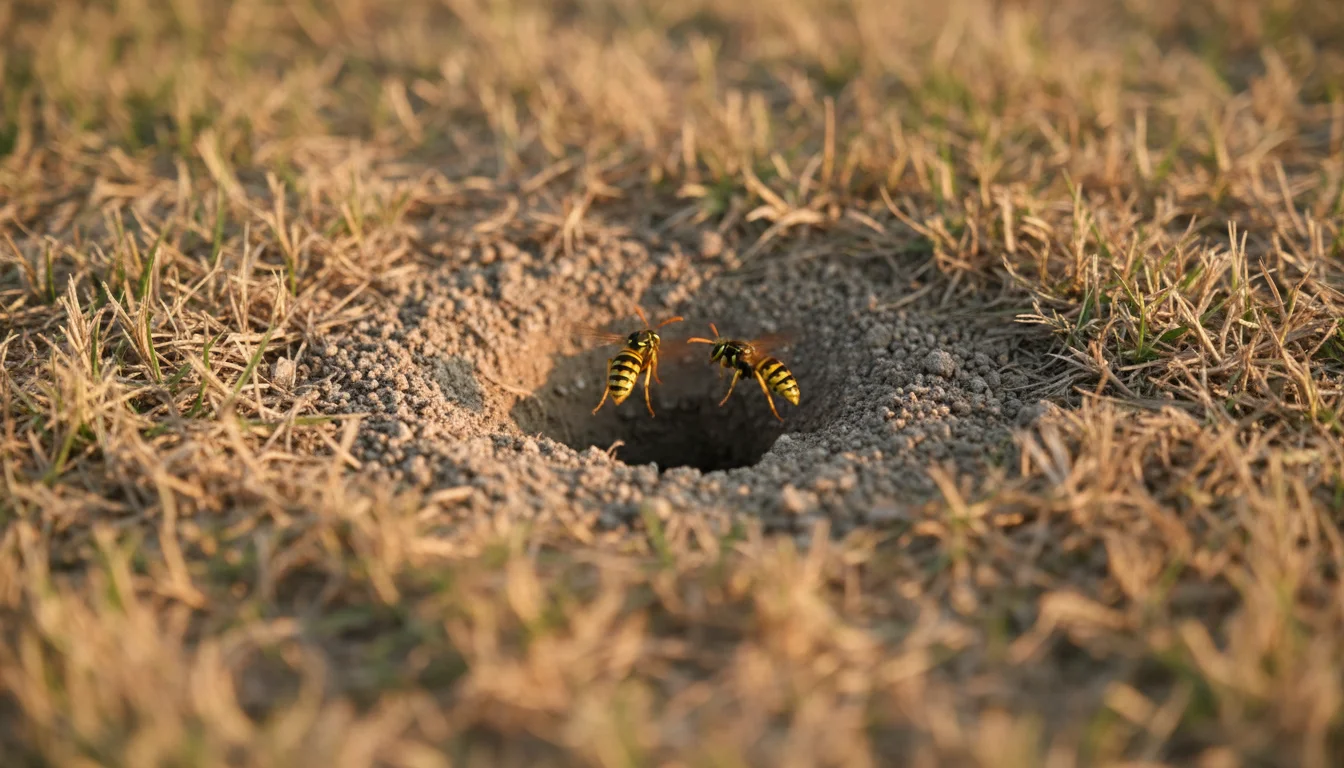
If you’re watching steady traffic of yellow-banded insects flying in and out of a hole in your lawn or a gap near the foundation, you’ve got yellow jackets. Fall is when they’re most dangerous – workers are defensive, the colony is at maximum size, and they’re protecting larvae. Treat them at dusk when the full colony is inside and slower-moving.
1. Spray ground hornets directly in the nest
The standard approach, and the right one to start with. Use an aerosol labeled for wasp and yellowjacket nests that lists in-ground nests as an approved use site, and follow that label for the amount, the spray distance, the protective equipment, and any re-entry time. Treat after dark when the whole colony is inside and slower, stand upwind, and aim the nozzle into the entrance hole so the spray penetrates the nest rather than just coating the surface.
Back away immediately. Don’t hang around to see if it worked. Workers can and do emerge even after treatment, and fall colonies can have several thousand of them.
Check the entrance the next day. If workers are still going in and out, treat again following the product label – a large nest can take several rounds before it goes quiet.

2. Insecticide dust for a ground nest
For a confirmed ground nest, a puff of insecticide dust down the hole is the method extension offices actually recommend. After dark, apply a dust labeled for wasps (permethrin-based dusts are common) down into the nest entrance itself, not just around the rim, so returning workers carry it inside. A hand duster, or a squeeze-bottle applicator on the end of an extension pole, lets you treat from a step back. Workers pick the dust up as they come and go and carry it inside, and the colony usually dies within a couple of days.
Wear whatever protective equipment the dust’s label requires, and keep your face back in case dust blows out of the hole. If the nest is under a structure, inside a wall, or you react badly to stings, stop and call a professional instead. The same dusting approach applies to other ground-nesting wasps, which is what most “ground hornet” nests turn out to be.
3. Wait and seal (free, slow)
If the nest isn’t in a high-traffic spot and it’s already late in the season, you can let winter do the work. Yellow jacket colonies are annual: only new mated queens survive, and the workers die once cold sets in. Extension guidance puts the killing cold at roughly 5 to 7 days below 45°F (7°C), so the exact timing depends on your local frost.
Give it until a real cold spell has passed, then watch the entrance in daylight. Once you see no workers going in or out, the colony is done and you can fill the hole with soil or caulk to tidy it up.
Filling an old ground nest is cosmetic, not prevention. Each colony is founded from scratch by a new queen who chooses her own site, and the old nest is not reused – so an unsealed hole is not what brings wasps back.
4. Call a pro
If the nest is near a doorway, a children’s play area, or anywhere you can’t approach safely, call a professional. Same if you’ve treated it more than once and it’s still active, or if anyone in the household has a sting allergy.
Fatal stings are rare – the CDC recorded 788 deaths from hornet, wasp, and bee stings across 2011 to 2021, an average of about 72 a year in the US – but the risk is real if you’re allergic. It’s not worth a hospital trip to save the cost of a pest-control visit.
FAQ
Are ground hornets aggressive?
Depends on the species. Yellow jackets are genuinely aggressive, especially in fall when the colony is at its largest and most defensive. Cicada killers, despite looking alarming, are solitary and rarely sting unless handled. If you’re not sure what you have, watch from a safe distance: yellow jackets get noticeably defensive as you approach the entrance, so keep as much distance as you can.
How bad is a ground hornet sting?
Yellow jacket stings are painful and – unlike bees – they can sting multiple times. For most people it’s a localized reaction. The serious risk is anaphylaxis in people who are sensitized. If you’re stung multiple times, or if you notice swelling spreading beyond the sting site, shortness of breath, or dizziness, get to an emergency room.
What do ground hornet nests look like?
A small hole in the ground, often in bare or thin-grass areas, with steady traffic of yellow-banded insects flying in and out. There may be a small mound of loose dirt around the entrance from excavation. These are easy to mow over – that’s the most common way people get stung without intending to disturb anything.
How to get rid of ground hornets permanently?
Kill the colony this season and you’re done. Yellow jacket nests are annual and are not reused – next spring’s queens each dig fresh sites of their own, so there is no colony waiting to return to the old hole. Filling the hole afterward is tidy but does not prevent new nests, and there is no need to treat the empty ground.
Corrections
- 2026-09-27: Swept out the remaining unsourced specifics. The dust step now points to the product label for protective equipment instead of naming a fixed kit. The aggression FAQ drops the “within a few feet” distance for a general “keep your distance.” Replaced the specific colony-size and nest-hole-diameter figures and the fixed pest-control price with plain descriptions, and softened the cicada-killer sting wording to match the source (Virginia Cooperative Extension). The shared wait-and-seal method record lost its unsourced “two weeks / 14 consecutive days / mild spell” timing in favor of the sourced cold condition (5 to 7 days below 45°F, Illinois Extension) plus a daylight activity check before sealing.
- 2026-09-27: Removed a few unsourced specifics from the treatment steps. The spray step no longer promises a fixed “two treatments” result – check the next day and re-treat per the label only if the nest is still active, and a large nest can need several rounds (Virginia Cooperative Extension). The dust step drops the unsupported claim that dusting only the rim angers the colony. The wait-and-seal step drops the invented 14-day and “mild spell revives stragglers” wording in favor of confirming no daytime flight activity after a genuine cold spell.
- 2026-09-26: Removed the food-grade diatomaceous earth method. Food-grade DE is not labeled or evaluated for pest-control use, and its effectiveness and risks for that use are unknown (NPIC).
- 2026-09-26: Removed the boiling-water method. Extension guidance advises against flooding a ground nest as a home remedy (University of Maryland Extension).
- 2026-09-26: Corrected the “wait and seal” section. The colony dies with sustained cold (roughly 5 to 7 days below 45°F per extension guidance), not a fixed 50°F or a December date, and sealing an old ground nest does not prevent new nests – yellow jacket nests are built from scratch each year by new queens and are not reused (University of Minnesota Extension; Illinois Extension). Removed the old-nest pheromone claim.
- 2026-09-26: Made the spray method label-led rather than naming universal active ingredients and a fixed spray duration; use a product labeled for in-ground wasp nests and follow its directions.
- 2026-09-26: Corrected the US sting-death figure to the CDC’s 788 deaths over 2011-2021 (about 72 a year) and removed the unsourced “almost all from allergic reactions” claim.
- 2026-09-26: Removed the gasoline pour for ground nests. Pouring gasoline into a nest is a fire, exposure, and groundwater-contamination hazard and is not an approved or safe control method (Penn State Extension; EPA petroleum-release guidance). Ground nests now use an insecticide dust labeled for wasps, applied down the entrance after dark, per extension guidance.