Table of Contents
Stage fright is your nervous system doing exactly what it was built to do. Face a room full of eyes and the same fight-or-flight machinery that handles real danger can switch on: heart rate spikes, hands shake, throat tightens, thoughts scatter. Nothing is wrong with you. Your body is bracing for a threat that was never going to hurt you.
What causes stage fright
The stage is rarely the real problem. What sets stage fright off is being watched and judged. The moment a performance feels like it’s being evaluated – a talk, an audition, an interview – the brain tends to treat the social stakes as a kind of danger and fires the same physical alarm it would for a physical one. A few things turn the dial up: high stakes, an unfamiliar room, and going in underprepared. None of that means you’re broken. It means the situation is doing what these situations do. The methods below work on different parts of that system – some on the physical symptoms, some on the mental framing, some on making the whole situation less threatening through preparation.

Physical regulation techniques
Your body is running the show more than you realize. The physical symptoms of stage fright do more than feel bad – a shaking hand or a tight throat can get in the way of the thing you’re trying to do. Targeting them directly is the fastest route to feeling functional again.
Deep belly breathing is the most reliable immediate intervention. Slow, diaphragmatic breaths can nudge the parasympathetic nervous system into gear and counteract the adrenaline response. The mechanics matter: breathe into your stomach, not your chest. A pattern many people use is a slow count in, a short hold, and a longer count out – the long, full exhale is the part that does the work. Give it a couple of minutes before you go on. It is far easier to start slowing your breath in the minutes before you walk on than to claw it back once you are already on stage and spiraling, so treat it as a warm-up, not only a rescue.
Standing tall – shoulders back, taking up space – won’t rewire your physiology the way the old “power pose” claims suggested; those results didn’t survive replication. But carrying yourself as if you’re ready can help you feel a little more assertive as you walk on. Treat it as a mental cue, not a switch.
Progressive muscle relaxation helps with the tension that builds in the hours before. Systematically tensing and releasing muscle groups can lower baseline tension going into the event. This is a waiting-room tool, not a rescue: you cannot tense and release your way through a talk you are already giving, so use it in the hours or minutes beforehand rather than at the lectern.
Two practical things that matter: skip caffeine before events, because it amplifies anxiety symptoms directly, and keep water handy, because a dry mouth is miserable when you’re already nervous and it’s easy to head off.
Mental reframing
Anxiety and excitement are both high-arousal states – racing heart, jittery energy, heightened alertness. What differs is the label you put on them, and that label is exploitable.
Reframing anxiety as excitement is backed by actual research. Saying “I’m excited” instead of “I’m nervous” – out loud, to yourself – measurably improved performance in public-speaking studies. Not because it’s positive thinking, but because you’re labeling the same aroused state with a different meaning. The state stays the same; what changes is whether it helps or hurts you.
Reframing negative thoughts means catching the catastrophic patterns (“I’ll forget everything,” “everyone will notice I’m nervous”) and challenging them with evidence rather than false cheer. Have you forgotten everything before? Do most people in your situation get through it? Swap the catastrophic read for a realistic one.
A positive affirmation is easier to believe when it’s specific and true: “I’ve prepared for this” rather than “I’m going to be amazing.” Generic optimism rings hollow. A claim you can back up doesn’t. Skip it if the only line you can come up with is one you don’t believe – a hollow affirmation you’re silently arguing with does more harm than none at all.
Mentally rehearsing the worst case is the opposite of what it sounds like. Walk through the worst realistic outcome – not the catastrophic fantasy, the actual worst case – and notice that you’d get through it. Fear of failure is partly fear of a consequence you’ve never looked at straight on. Look at it, and it tends to shrink.
Focus and anchoring
One of stage fright’s most damaging effects is on attention. Your focus turns inward – onto how you’re doing, how you look – at exactly the moment you need it pointed outward, at your content and your audience. Turning inward tends to make the anxiety worse, so anchoring techniques exist to redirect it.
A mental focus anchor is a single word or phrase you return to when anxiety tries to hijack your attention. It gives your mind a deliberate target instead of the spiral. Pick a word that comes to you automatically; if you have to hunt for it mid-spiral, the anchor becomes one more thing to manage instead of the thing that steadies you.
An anxiety focal point works a little differently: pick one specific object in the room and let your attention settle there for a beat when things start to spin. A fixed point outside your head is easier to hold than a racing one inside it. Choose the object before you start, not while you are panicking, and pick something that stays put – a clock counting down or a face you keep checking for a reaction will pull you straight back inside your head.
Focusing on your body center – the area just below your navel – pulls attention into physical sensation instead of runaway thought. When you’re tracking a physical anchor, there’s less room for the mental spiral. It takes a little practice: the first few tries, your attention slides straight back to the thoughts, so try it in a calm moment before you lean on it under pressure.
Setting a clear performance intention swaps “don’t mess up” for an active goal: “help this audience understand X.” Aiming at something you want to do, instead of something you want to avoid, gives you a clearer job to focus on.
Visualization
Visualizing a successful outcome means running through the performance in your mind in real time, not just picturing a vague success. See the room, feel the nerves, deliver the first line anyway, build momentum. Athletes have leaned on this for decades. The neural pathways active during vivid mental rehearsal overlap significantly with those used in actual performance – it’s rehearsal through a different channel.
Preparation and rehearsal
This is the category that makes every other technique work better. Mental reframing is easier when you’re genuinely prepared. Physical regulation is more effective when it isn’t also fighting real under-preparation panic.
Rehearsing under real conditions means doing it out loud, at speed, in front of at least a small audience. Silent run-throughs in your head don’t produce the same effect; speaking in front of even one person produces real nerves, and that’s the point. Practice with them.
Visiting the venue beforehand removes one source of uncertainty. Walk the room, stand where you’ll stand, look at where the audience will be. A space you’ve already been in is one less unknown on the day.
Inviting a supportive person into the audience gives you somewhere friendly to look. A familiar face you can return to when the nerves spike is a small thing, and on the day it can steady you. Brief them first, though: someone who nods and looks engaged helps, while a friend who pulls faces to make you laugh or keeps glancing at their phone can throw you off worse than a room of strangers.
Preventing stage fright
You can lower the odds of a bad case before the day arrives, and the two biggest levers are experience and preparation. The more often you put yourself in front of people – small stakes first, then larger – the less novel the whole thing feels, and repeated exposure like that is one of the few approaches shown to bring performance anxiety down over time. Prepare far enough ahead that you’re not cramming the night before; rested and rehearsed is a different starting line than tired and winging it. And keep your day-of inputs boring: sleep, food, water, and easy on the caffeine.
Where it shows up
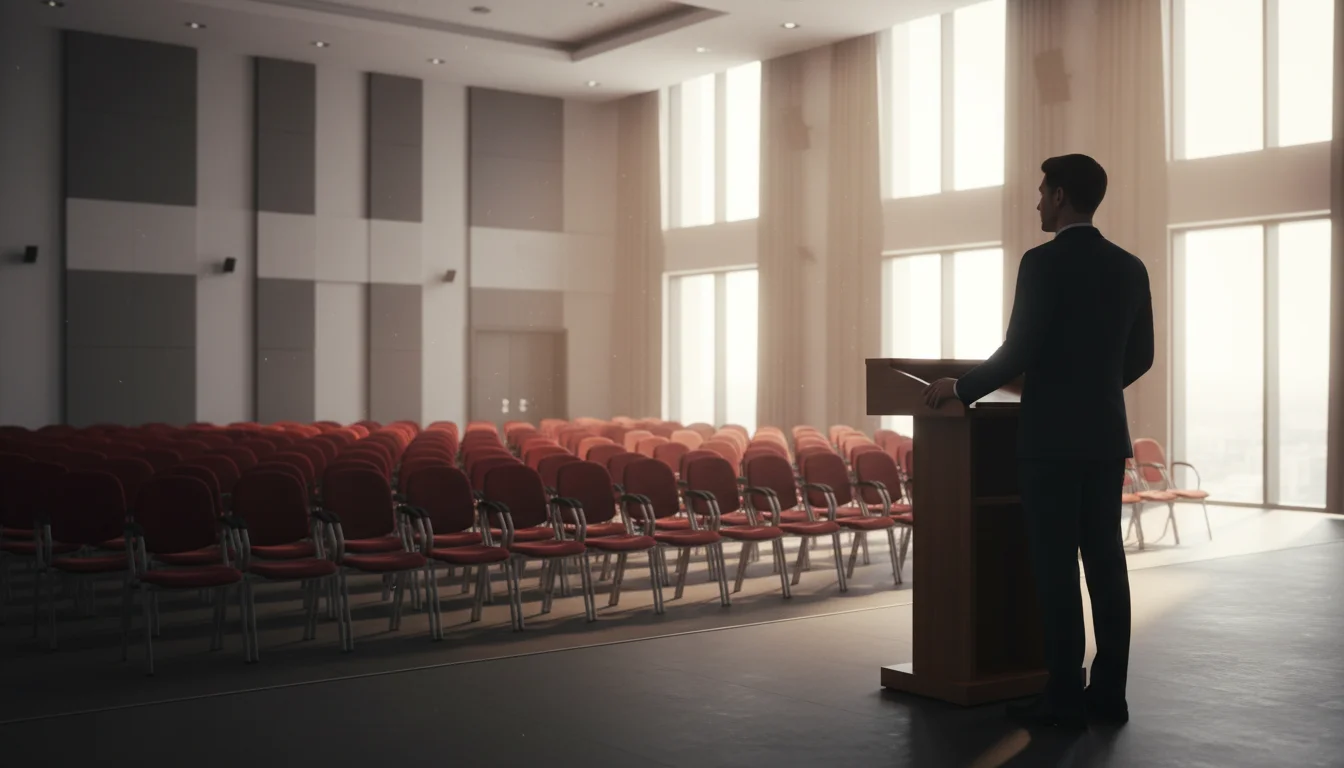
Stage fright responds differently depending on how you approach it. How to get rid of stage fright with physical techniques covers the body-based interventions in full: breathing, posture, grounding, and the physiology behind why they work. How to get rid of stage fright with mental techniques goes deep on reframing, visualization, and the cognitive tools for managing performance anxiety. And how to get rid of stage fright with preparation covers the practical logistics: rehearsal methods, venue familiarization, and the day-of routine that keeps the system from crashing.
Stage fright FAQ
How do I calm stage fright in the moment?
Start with your breath: slow it down and make the exhale longer than the inhale. Then pick one fixed point outside your head – an object on the far wall, a friendly face – and let your attention rest there. Both pull you out of the internal spiral faster than trying to talk yourself calm.
Does stage fright ever fully go away?
For most people it fades rather than vanishes, and that’s fine – a little arousal sharpens performance. The goal isn’t zero nerves; it’s nerves you can work with. Repeated exposure, small stakes first, is what tends to bring it down over time.
When should I get professional help for stage fright?
When it stops being about a single event. If performance anxiety is persistent and it’s pushing you to avoid things you care about – turning down opportunities at work or school, dropping activities, or dreading them for weeks – that is worth raising with a doctor or a mental health professional. Anxiety that interferes with everyday life is treatable, and a talking therapy such as cognitive behavioral therapy is a common first step.
Corrections
- 2026-09-17: Removed a claim that holding an expansive “power pose” for two minutes produces a beneficial physiological change. Later replication studies did not support that effect, so the posture tip now stands only as a way to feel more assertive, not as a physiological reset.
- 2026-09-17: Corrected “the physical symptoms of anxiety and excitement are identical” to the accurate point that both are high-arousal states differing mainly in how you label them.
- 2026-09-17: Removed the claim that the focus anchor works “because the brain can only hold one thing at a time,” which experimental work contradicts; the anchor is now described simply as giving attention a deliberate target.
- 2026-09-17: Dropped the specific four-four-six breathing count presented as a proven protocol, along with several unsupported mechanisms (dehydration raising heart rate, a martial-arts provenance for center-focus, night-before anxiety worsening day-of nerves). The practical instructions remain; the unverified explanations do not.
- 2026-09-17: Added a “when to get professional help” threshold for persistent performance anxiety that interferes with everyday life.