Table of Contents
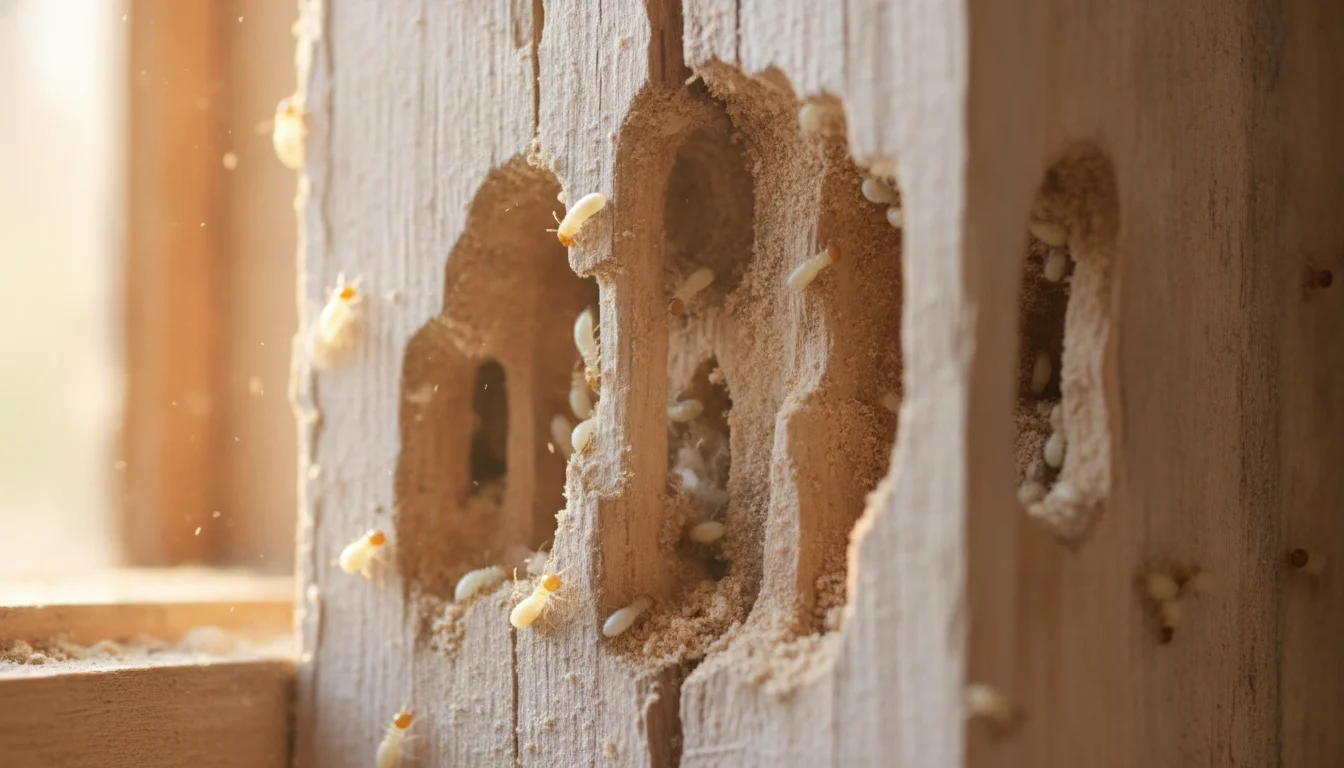
Wood termites work slow, and that’s exactly why they wreck things. By the time you hear the hollow knock in a beam, spot paint bubbling, or find mud tubes running up the foundation, they’ve been eating for months or years. Wood termites are one branch of the wider termite problem, and the branch homeowners meet most. Here’s the part most termite pages won’t tell you straight: the orange oil and neem and salt-water sprays people swear by have never been shown to clear a real infestation. What actually moves the needle for a homeowner is smaller and less exciting. Work out which termite you’ve got. Kill the moisture feeding them. Pull out the infested wood you can reach. And hand anything structural or subterranean to a licensed pro.
Which termite matters, because it decides what you can and can’t do yourself. Drywood termites live inside the wood and can sit hidden for years, giving themselves away with blistered wood or shed wings before you ever see the insect. Dampwood termites need wood that stays genuinely wet. Subterranean termites live in the soil and forage up into the structure through mud tubes, and those are the ones UC IPM says homeowners are unlikely to control without professional inspection and a proper treatment program.
Prevention and habitat control
The best termite control is the infestation you never get, and two things drive almost all of it: moisture and wood touching soil.
Moisture control is the big one. Damp wood pulls termites in, and dampwood species need wood that stays wet, so drying things out takes away the conditions they depend on. Fix the leaks. Move water away from the foundation. Ventilate the crawl space. Run a moisture meter over the spots you’re worried about. UC IPM and UF/IFAS both put dry foundations and corrected moisture at the top of the prevention list, ahead of anything you spray.
Sunlight and drying out is the move for a piece you can carry outside: get it off the ground, out of the damp, into the sun. That strips the moisture drywood and dampwood termites rely on. It is not a reliable colony kill – direct sun won’t drive the core of the wood to the temperature and hold time that actually does that, which is a job authorities put in professional hands – but for a movable, lightly infested piece it’s a cheap first move.
And keep wood off soil. Firewood on a rack, not the ground. No mulch heaped against the siding. No untreated posts sunk straight into dirt. Wood-to-soil contact is a direct invitation to subterranean termites, and cutting it is one of the few things a homeowner can do that genuinely lowers the risk.
Natural and organic treatments
Here’s the blunt version: the natural termite treatments all over the internet don’t have the evidence the headlines imply. UC IPM says home-use products aren’t effective against drywood termites, and the university entomologists who’ve actually tested the popular ones keep landing on "not demonstrated." Try them on a small, accessible, early problem if you like. Don’t bet your beams on them, and don’t let them stall an inspection.
Orange oil is the most hyped of the lot. It’s d-limonene, and it does kill termites it directly touches. That’s also the catch. Texas A&M says orange-oil sprays haven’t shown they control termites in an actual structure, and UC IPM calls the efficacy questionable. It doesn’t travel through wood, so anything it can’t physically reach lives.
Boric acid is the one "natural" chemistry with real standing, but read the fine print. The EPA recognizes borates as a wood treatment soaked into bare wood during construction, and Texas A&M says treating an existing home with them gives only partial protection. Dusted into a crack as a powder, don’t expect it to reach a colony you can’t see.
Neem oil shows up on every list. UC IPM counts it among the botanical treatments people have tried, but it doesn’t back the tidy "disrupts molting and wrecks the colony" story you’ll read elsewhere. Results are variable and localized at best.
Diatomaceous earth dehydrates insects it coats, it’s cheap, so people ring the foundation with it. No authority shows it protects a structure from termites – the EPA notes some lab success for nonchemical agents, not demonstrated structural control – and it’s useless the moment it gets wet.
Cayenne pepper, vinegar and salt water round out the folk end of the shelf. No authority source backs any of them as a termite treatment. They’re the kind of thing you reach for because they’re already in the cupboard, not because they’ll clear an infestation.
Physical methods
Heat treatment genuinely kills termites, every life stage and eggs included, but only when the whole piece of wood, core and all, reaches at least 120°F (49°C) and holds there for 33 minutes or more. That’s controlled, whole-structure work that licensed applicators do with real equipment. A hair dryer and an infested chair leg won’t get the core hot enough for long enough, so don’t treat DIY heat as the answer for anything that matters.
Cardboard bait traps lean on termites’ love of cellulose: wet cardboard near known activity draws them in, then you bin it. Texas A&M is clear that DIY cardboard bait hasn’t shown it controls termites, and the cardboard rots fast. At most it tells you where they’re active. Professionals use engineered in-ground monitoring stations for that, not a soggy box.
Beneficial nematodes, the Steinernema worms sold as a soil drench, are a staple of natural-pest lists. In a lab they infect termites. In an actual structure they don’t deliver: Texas A&M says they haven’t proved effective against termites and can’t be recommended, and the EPA’s successes are lab-bound. Skip them for a house.
Termite barriers are the physical method that actually pulls its weight, but mostly before there’s a house on the lot. Stainless steel mesh and graded stone go in under slabs and around foundations during construction. Soil termiticides are a professional application. Retrofitting either into a finished home is a contractor’s job, not a Saturday’s.
When to call a professional
For plenty of termite problems the honest answer is that this one isn’t yours to fix. Call a licensed pro when:
The termites are in structural wood, load-bearing beams, or the foundation. Home treatments don’t penetrate deep enough, full stop.
You think they’re subterranean. Mud tubes, a swarm near the foundation, or activity in several spots around the perimeter point to a soil-based colony that can run enormous, and UC IPM says homeowners are unlikely to control one without professional inspection and an integrated program.
You’ve got a drywood infestation past a single movable piece. UC IPM doesn’t recommend DIY drywood treatment beyond removing the infested wood itself. So if you can’t just take the wood out, book an inspection rather than dosing the house with remedies while it keeps eating.
Where wood termites show up
Termite work splits three ways, and each has its own page. How to get rid of wood termites with natural treatments walks the organic options – orange oil, borates, neem and the rest – and, more usefully, where each one stops. How to get rid of wood termites with physical methods covers heat, nematodes, cardboard traps and barrier systems and what they realistically do. And how to get rid of wood termites with prevention is the one that pays off: moisture control, keeping wood off soil, barriers, and the professional treatments worth understanding even when someone else applies them.
Corrections
- 2026-09-16: Earlier versions called DIY treatment "genuinely viable" for early drywood and dampwood infestations. It isn’t. UC IPM does not recommend homeowner drywood treatment beyond removing the infested wood, and home-use products are not effective. The homeowner’s real levers are moisture control, cutting wood-to-soil contact, removing accessible infested wood, and a licensed pro for anything structural or subterranean.
- 2026-09-16: Direct sunlight was described as killing a termite colony above 120°F. It does not reliably do that. Only heating the full core of the wood to at least 120°F (49°C) for 33 minutes or more kills termites, which is professional whole-structure work; sun and drying help only by removing the moisture the termites need.
- 2026-09-16: Orange oil and the other natural treatments were described as working on drywood termites. Texas A&M and UC IPM find orange-oil efficacy unproven in real structures, and no authority backs neem, diatomaceous earth, cayenne, vinegar or salt as a termite treatment. The text now says so.
- 2026-09-16: The claim that a homeowner can heat-treat furniture with portable equipment is removed. Effective heat treatment is a professional job.
- 2026-09-16: Beneficial nematodes and DIY cardboard bait are no longer presented as effective. Texas A&M reports neither controls termites in an actual structure.
- 2026-09-16: The "wait 6-8 weeks before calling a professional" line is removed. It could delay an inspection while damage continues.
- 2026-09-16: The exact "19% moisture content" cutoff for dampwood termites is removed. Authorities say these termites need moist or wet wood but do not support that specific figure.