Table of Contents
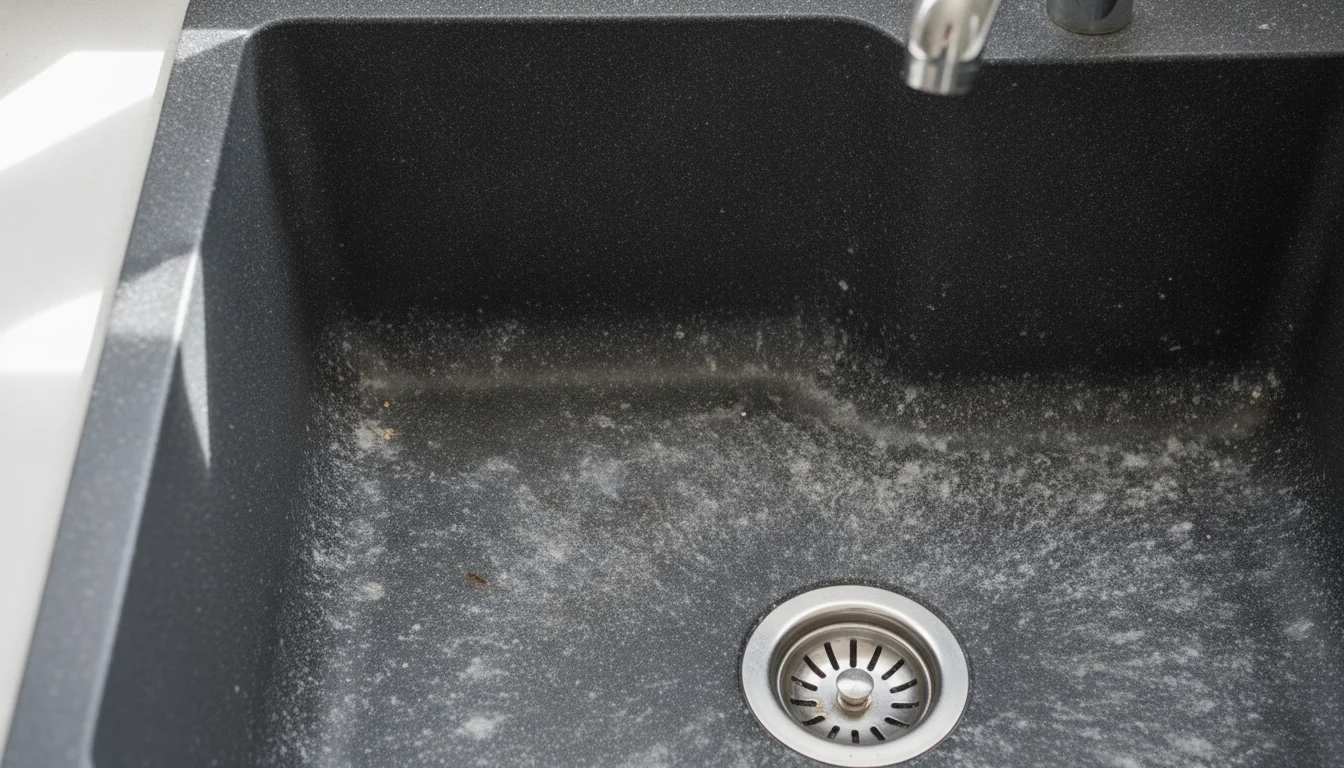
Most of what shows up on a black composite sink is limescale, which is good news if you’re working out how to get rid of stains on black composite sink surfaces. Tap water dries and leaves its minerals behind, and on matte black that reads as a pale haze, a white ring around the drain or a chalky film soap won’t touch. That comes off. So do soap residue, gray pan marks and coffee or tea held in the scale.
What doesn’t come off is the gray-white patch that appeared right after bleach, oven cleaner or a very hot pan. That’s damage to the surface, and the best you can do is hide it.
Then there’s the advice. One site says leave vinegar on for 30 minutes; another says acid must never touch the sink. Moen’s care guide bans scouring pads, then names one for difficult stains. Here’s where the makers agree and where they split.
What causes stains on a black composite sink
Blanco and Franke agree that coffee, tea and red wine don’t stain the composite itself. They stick to limescale: in hard-water areas, Franke says, gray or colored “stains” are mineral layers that soak up whatever you pour over them. Get the scale off and the stain goes with it.
Gray streaks are usually metal. The composite is harder than most metals, so a dragged aluminum pan leaves a trace of itself behind, and Franke says that isn’t permanent.
Damage is different. Franke lists concentrated bleach, chlorine products, acids such as kettle descaler, caustic soda (drain cleaner) and oven cleaner as causes of “permanent irremovable stains, or surface etching.” Heat does it too: Franke rates its sink at 536°F (280°C) for 10 to 15 seconds, and hot oil runs hotter than that. The rule of thumb: a mark that built up over weeks is film. A mark that appeared the day something harsh or hot hit the sink is damage.
| What you see | What it usually is | Start with |
|---|---|---|
| Pale haze, white ring at the drain | Limescale or soap film | Methods 1, 3 |
| Brown or beige marks | Coffee or tea held in limescale | Methods 3, 4 |
| Gray lines | Metal from pans | Method 5 |
| A patch nothing has moved | Set-in grime and scale | Methods 6, 7 |
| Gray-white blotch after bleach, oven cleaner or heat | Surface damage | Methods 8, 9 |
1. Wash it, dry it, then look again
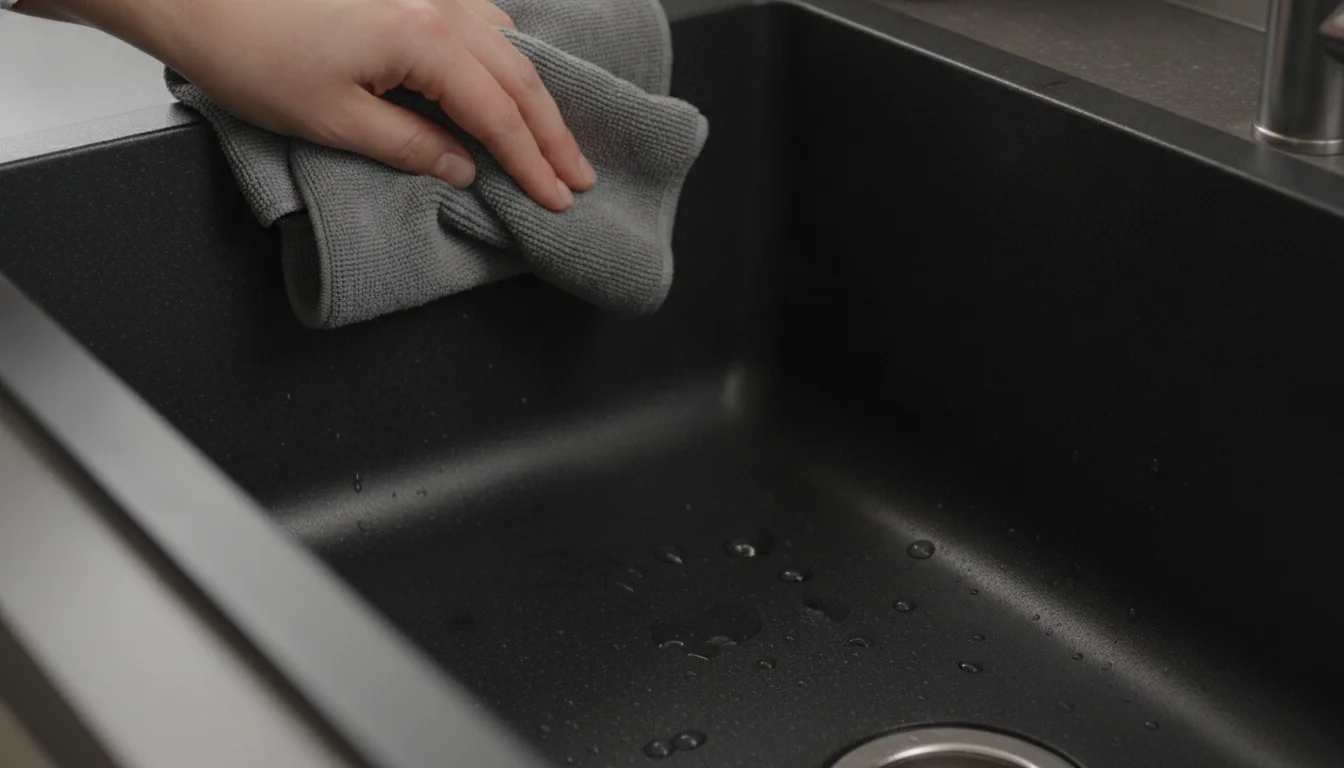
Warm water, a squeeze of dish soap (about 1 teaspoon per quart, or 1 L) and the soft side of a sponge. Wash the bowl, rinse, then dry it completely with a microfiber or cotton cloth.
The drying is the point. A wet black sink looks clean; a dry one tells the truth. Plenty of “stains” are soap residue and end right here.
2. Check what your sink’s maker allows
Find the brand (receipt or installer) and read that maker’s care guide before anything stronger goes on. They don’t agree.
Moen wants a Magic Eraser with water or a 50/50 white vinegar mix. Franke allows vinegar left on for hours, and its own colored-sink cleaner with a Scotch-Brite pad. Blanco points you to its own limescale cleaner, BLANCOCLEAN Daily+, left on for 1 to 2 minutes. Ruvati is fine with Bar Keepers Friend or CLR. Rene Sinks says keep citrus-based cleaners away entirely.
Where they overlap: no straight bleach, no steel wool, and Moen, Franke and Blanco all rule out drain cleaner. Whatever you try that isn’t the maker’s own product, test it on a hidden spot first.
3. Diluted white vinegar for white film and rings
This is the one most makers name for limescale, in two strengths. Franke’s slow version: 1 part vinegar to 3 parts water, left for several hours, preferably overnight. Ruvati’s quick version: 50/50 vinegar and water, left 15 to 30 minutes.
Plug the drain and cover the bottom of the bowl. Then scrub in small circles with the stiff side of a non-scratch sponge, rinse thoroughly with clean water, and dry.
Keep it for buildup, not daily cleaning. Franke and Ruvati both set daily care as dish soap on a soft cloth or sponge, and Franke turns to vinegar only “if deposits remain.” Nantucket Sinks allows a vinegar soak for lime but warns that acid poured into the sink can “damage it beyond repair.” If your maker bans acid, use its own cleaner instead.
4. A melamine sponge for what the vinegar left
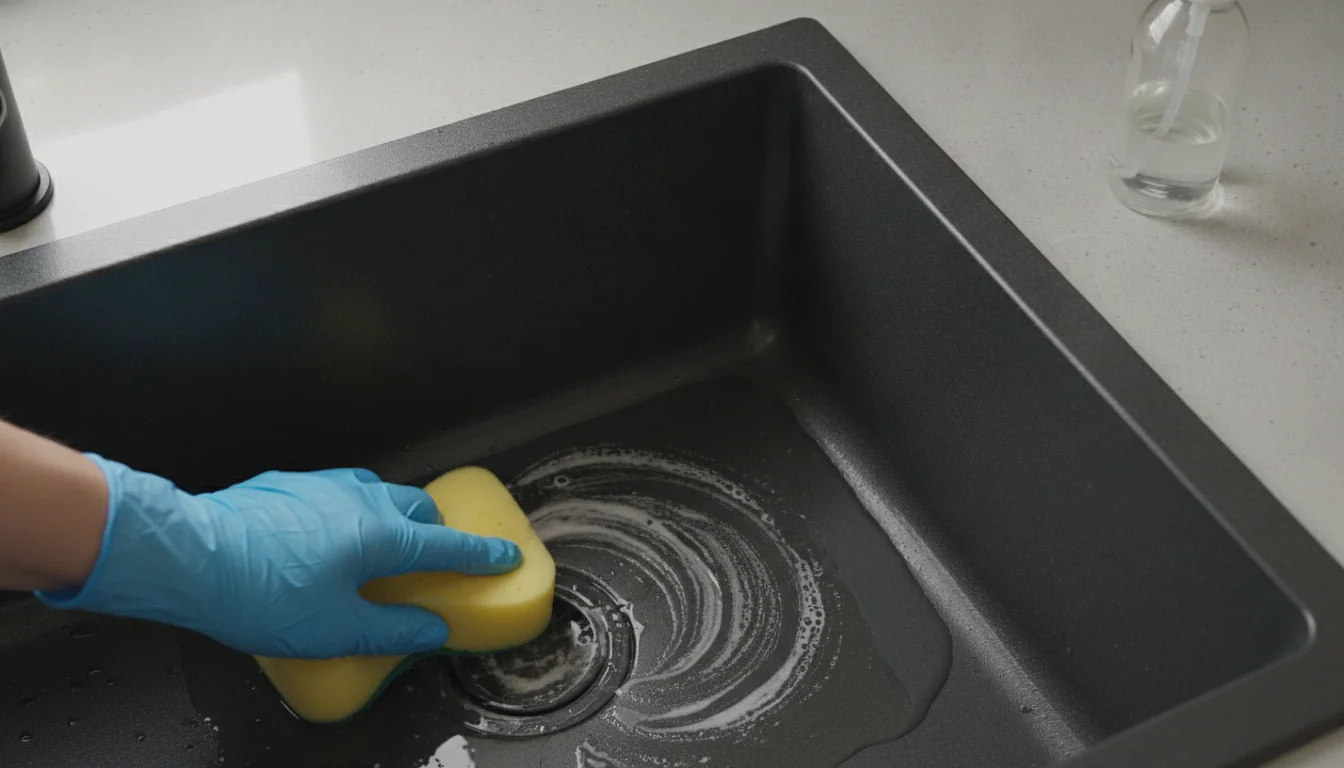
Moen’s step for stubborn stains and water marks is a Magic Eraser, wet with plain water or the 50/50 vinegar mix, then a towel dry. Rene Sinks uses the same thing for discoloration from rusty water or oily residue.
Melamine foam (the same stuff that takes scuff marks off walls) works like very fine sandpaper. On a matte finish, use light pressure on just the mark and check every few strokes.
5. Oil on a soft sponge for gray pan marks
Blanco’s fix sounds wrong and works. Put a little cooking oil on the soft side of a wet sponge, rub the gray lines in small circles, and the oil and water lift the metal off. Rinse with warm water until all the oil is gone, then dry with a microfiber cloth.
6. Cream cleanser and a non-scratch pad
For difficult stains, Moen’s guide says to use a Scotch-Brite Heavy Duty Scour Pad with water, the vinegar mix or a non-abrasive cleaner. Work in circles with steady pressure over the stain, rinse, dry, and let it dry for 5 to 10 minutes before you judge. Still there? Repeat. Franke’s version is a creamy cleanser on a soft scourer pad. Ruvati recommends Bar Keepers Friend Cleanser for its deep clean.
Yes, Moen bans scouring pads on the same page. Read it as “nylon, never metal”: Franke warns steel wool can embed in the surface and look like a stain. And check the label, because Franke notes some cream cleaners contain bleach.
7. Soak the bowl overnight with a dishwasher tablet
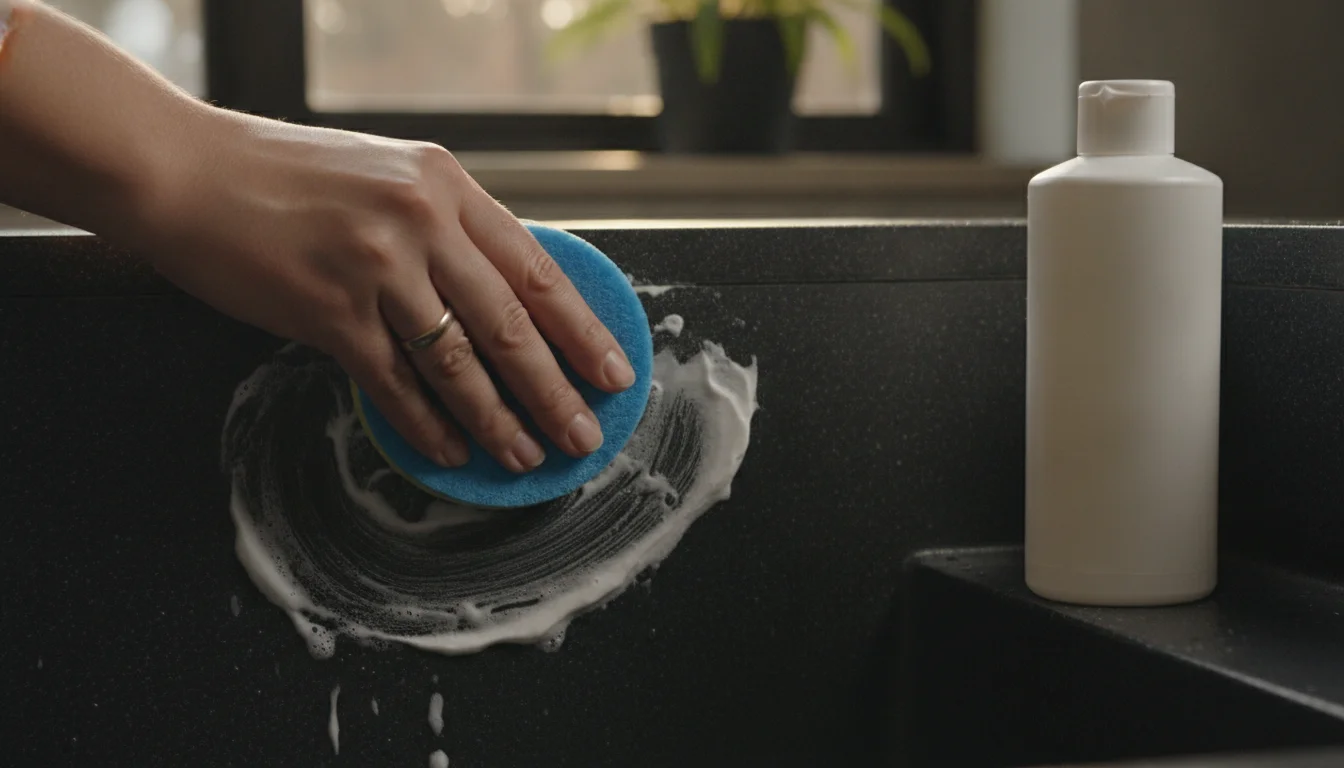
Franke’s answer to a set-in stain is time. Put the stopper in, fill the bowl with warm water, dissolve one standard dishwasher tablet and leave it for up to 12 hours. Drain, rinse thoroughly, dry.
Franke’s alternative is 40 parts water to 1 part bleach, recommended especially for light-colored sinks. On black, use the tablet or biological washing powder instead. Neither is routine cleaning.
8. Mineral oil to hide what won’t come off
Ruvati finishes every deep clean with a coat of mineral oil or granite sink polish on a microfiber cloth. A few drops, rubbed over the whole bowl, then buffed until the surface isn’t tacky.
Oil darkens a dull or bleached patch so it blends in. It repairs nothing, and it fades: one owner’s verdict was that it brings the color back “until you run water again.”
9. Call the maker before you make it worse
A blotch that appeared after bleach, oven cleaner or a hot pan, or a stain that survived every step your maker allows, goes to the maker’s customer care line. Tell them the model, color, when it appeared and what you’ve put on it.
Ruvati’s guide goes as far as wet-sanding scratches (80 to 100 grit, then 200 to 400). That’s Ruvati’s call for Ruvati’s sink, not a fix to try on another maker’s finish.
How to keep it from coming back
Dry the sink after you use it. Franke, Moen and Ruvati all come back to this, because limescale forms as water evaporates. A microfiber cloth by the faucet beats any cleaner.
Don’t leave wet sponges, cloths or a plastic sink mat in the bowl overnight; Franke says they trap water and leave scale underneath.
Let pans cool before they go in (Nantucket Sinks says a pan just off the burner can top 1,000°F, or 538°C) and run cold water while you pour boiling water. If oven cleaner or paint stripper splashes in, flush it with water straight away, as Moen advises.
Frequently asked questions
How do I get rid of white marks on a black composite sink?
Most are limescale or soap film. Wash and dry the sink, then soak the marks in diluted white vinegar if your maker allows it, scrub gently, rinse and dry. A white patch that appeared right after bleach, oven cleaner or heat is damage, and mineral oil will only hide it.
What is the downside of a composite sink?
A dark matte finish shows every mineral mark, and concentrated bleach, oven cleaner, drain cleaner or very hot pans mark it permanently.
Is a granite composite sink easy to clean?
Day to day, yes: soap, water and a dry cloth. For anything stronger, the makers’ approved lists differ, so check yours.
Are black sinks difficult to clean?
They aren’t dirtier, they just show more. Pale, cloudy patches on a black sink are usually hard-water deposits, not damage. Stainless has its own version: streaks and water spots.