Table of Contents
How to get rid of grubs in lawn starts with a spade, not a product. Most lawns with grubs don’t need a grub killer at all. The trouble starts when the count climbs, the roots go and the turf peels back like an old rug, or when a skunk works out what’s down there.
So it comes down to three questions, in order. Are there enough to matter? What month is it? And is a dog going to be on that grass tomorrow? The month decides more than the brand does. A preventive that wipes out June hatchlings does little to fat grubs in October.
How to get rid of grubs in lawn: first, why they’re there
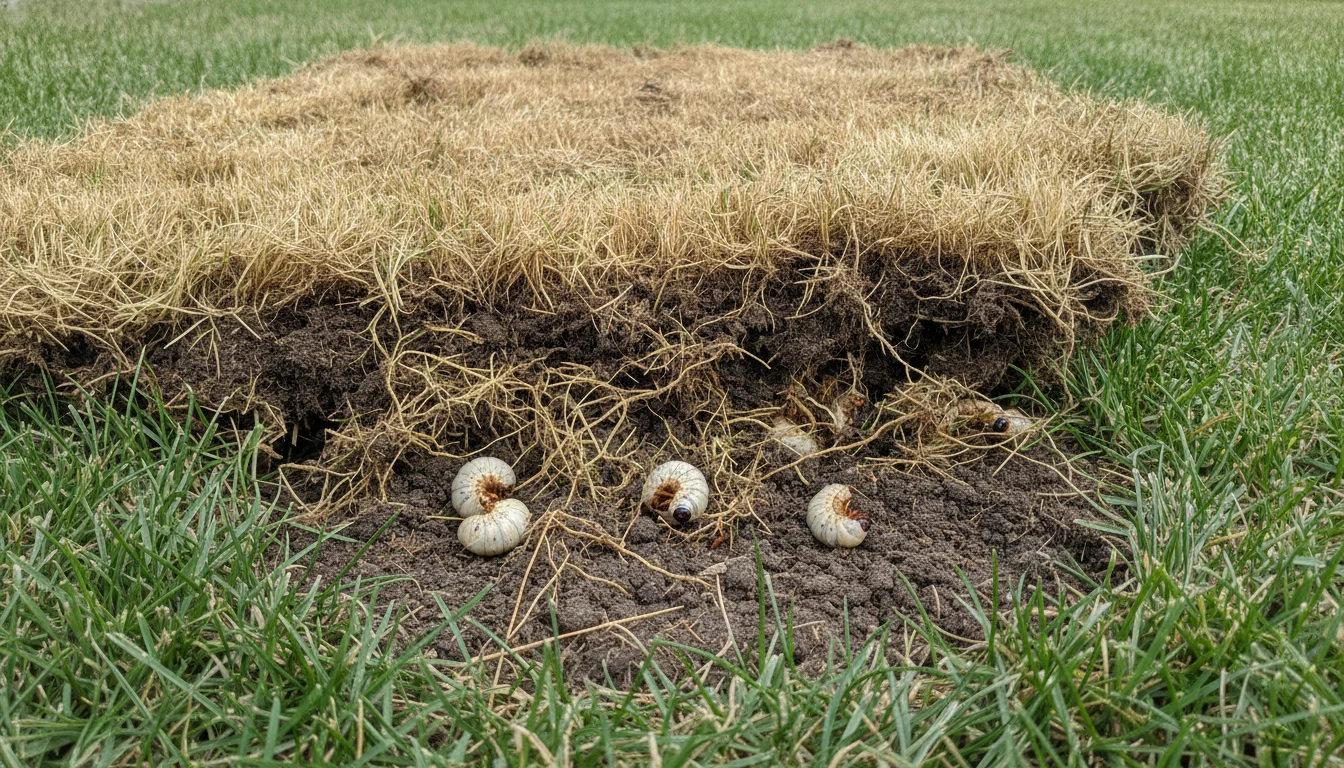
Lawn grubs are the larvae of scarab beetles: Japanese beetles, June beetles, chafers and Oriental beetles. The adults emerge in early summer and lay eggs in the turf. The grubs hatch later in summer, eat grass roots until mid-fall, go deeper for winter, come back up in spring and turn into beetles. That’s why dead patches appear in late summer and early fall.
A thin, drought-stressed lawn shows damage at a lower count than a thick one. And not every brown patch is grubs: UNH Extension lists disease, drought, chinch bugs, sod webworms, shade and compaction as look-alikes, and UC IPM adds dog urine.
1. Tug the grass, then dig a square foot and count
Start with the tug test. Grab a handful of grass at the edge of a brown patch and pull. A lawn browned by a dry spell stays anchored and greens up after rain. Grub-damaged turf peels away like a carpet because, as the New York Botanical Garden puts it, most of the roots are gone.
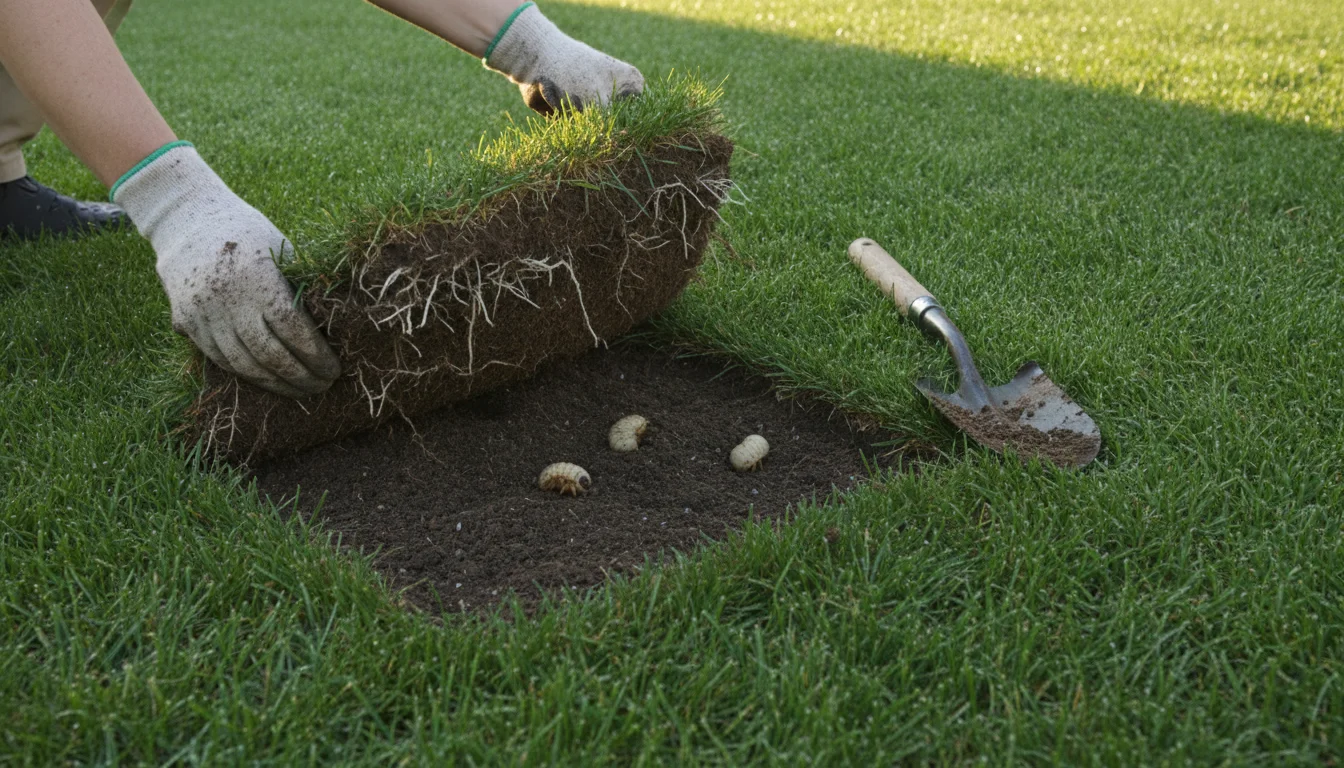
Then count. Cut three sides of a one-foot square with a spade, 2 to 4 inches (5 to 10 cm) deep, fold it back and count the C-shaped white grubs. Do several spots, including green grass beside the damage, and note the numbers. Put the turf back and water it.
The thresholds don’t agree, so here they are side by side:
- UC IPM: up to six per square foot can usually be tolerated.
- NYBG: eight or more, take action.
- UNH: ten or more is serious, a few is normal.
- Iowa State: healthy turf can carry 20 or more before it shows injury, but five or more brings in skunks and raccoons.
Our line: under five, leave it. Ten or more, treat those spots. In between, it depends on whether the turf is thinning or animals are digging. Count in late summer or early fall, when grubs feed near the surface.
2. Put down a preventive in early summer
Iowa State calls preventives applied from late May to early August the most effective grub treatment, worth it where damage comes back every year. They kill newly hatched grubs and work poorly on big ones, so timing is everything. UNH gives the windows:
- Chlorantraniliprole: late April into early June. UNH notes the US EPA designates it low-risk because of its low toxicity to bees. This is the one we’d pick.
- Imidacloprid, thiamethoxam, clothianidin: mid-June to early August. UW-Madison warns these neonicotinoids can pose risks to bees and other pollinators.
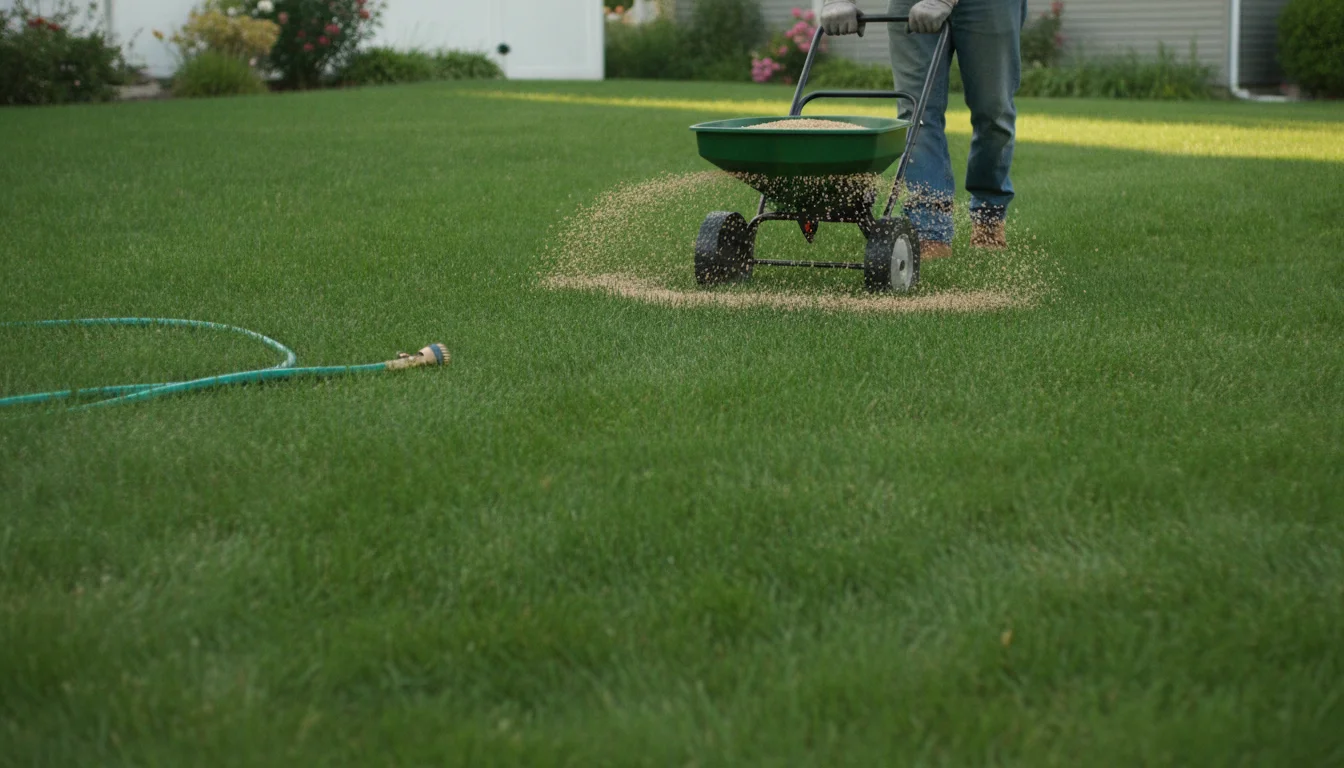
Spread at the label rate and water in about ½ inch (13 mm) straight after. UW-Madison is blunt: skip the watering and you get poor control.
Pets: a chlorantraniliprole label (EPA Reg. 279-9710) says keep people and pets off until the dust has settled, watering-in is complete and the area has dried. An imidacloprid granule label (EPA Reg. 72155-31) says the same.
3. Use a curative only in late summer, only where the count is high
Missed the preventive window and counted ten-plus? Then trichlorfon or carbaryl, which kill on contact. Iowa State says August and early September work best and anything after early October doesn’t. A trichlorfon label gives July through September.
Keep expectations low. UNH reports results as low as 20 to 25% control, and these products kill beneficial insects too, which is why NYBG suggests spot treatments over blanket ones.
The trichlorfon label says water thoroughly within 24 hours, don’t mow until it’s watered in and dry, and “children and pets may re-enter only after the treated area has been watered and allowed to dry.” UC IPM says grubs can take up to 10 days to die, so wait before judging.
A bag with only a pyrethroid (bifenthrin, gamma-cyhalothrin, lambda-cyhalothrin) and a grub on the front is a waste of money. UNH cites Michigan State research showing they don’t work on grubs.
4. Apply beneficial nematodes for the pet-friendly route
Heterorhabditis bacteriophora (sold as Hb nematodes) are microscopic worms that get inside a grub and kill it. They won’t hurt pets, so this is the answer to “grub killer that’s safe for dogs.” But they’re fussy:
- They must be alive. One Reddit gardener’s online order arrived hot, and the nematodes dead. Buy from a reputable supplier and use them right away.
- Sun kills them within a minute, says UNH. Apply on an overcast day, early morning or evening.
- Water before and after (UC IPM), and don’t let the soil dry out.
Apply in late summer or early fall when grubs are small. As a curative, UNH says you may need to repeat every two weeks. UW-Madison calls biological control limited and highly variable compared with chemicals.
5. Pin netting or wire over the patches animals dig
Skunks leave nose-holes that merge into one torn patch. Raccoons flip sod over, sometimes so neatly it looks rolled. Both dig at night, mostly in late summer and fall.
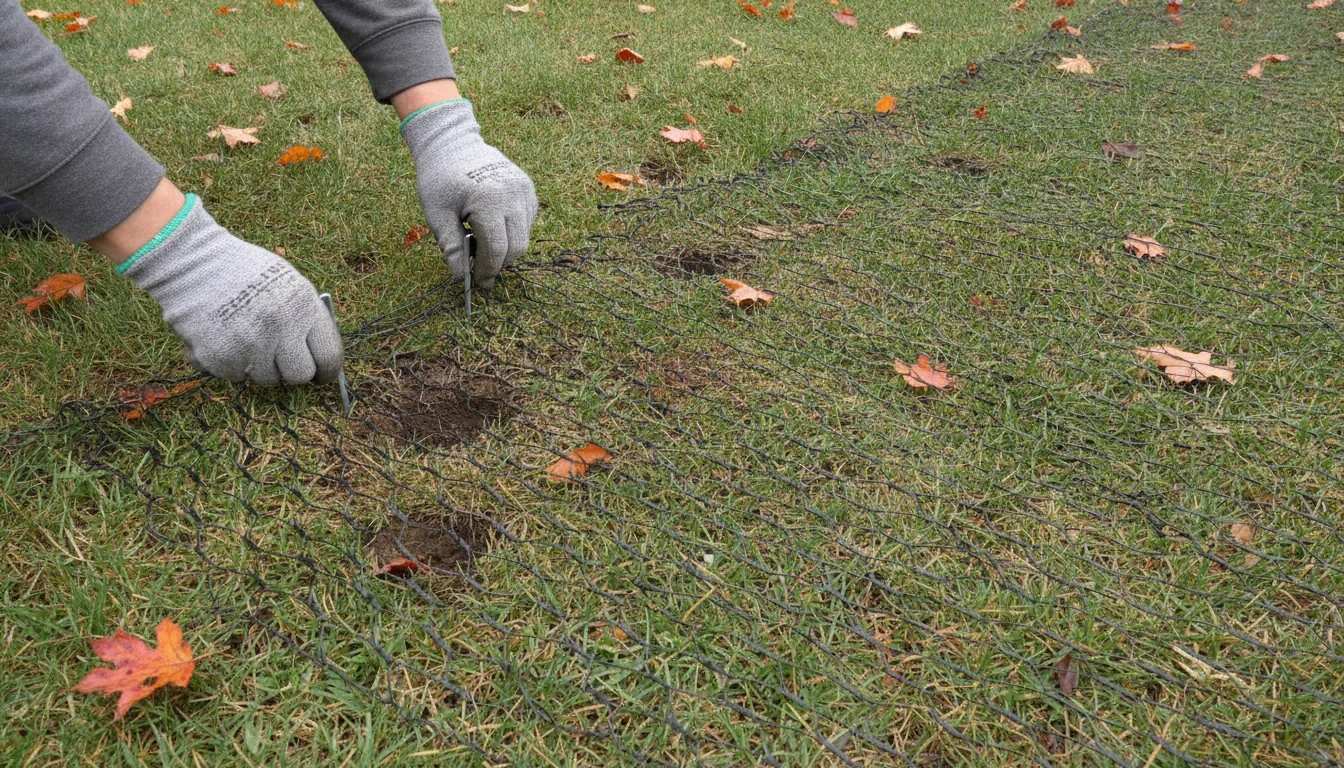
Iowa State calls exclusion often the most effective fix. Press the sod back, lay hardware cloth, chicken wire or bird netting over it and pin it with landscape staples or bricks. A determined raccoon can still get through, but it usually moves on. Scent repellents? Iowa State rates them typically not very effective. More in our skunks and raccoons guides.
6. Mow high and feed the lawn properly
Deep roots tolerate more grubs. UNH says mow at least 2 inches (5 cm), ideally 3 inches (7.5 cm) or more, and test the soil every two to three years. NYBG goes to 3½ to 4 inches (9 to 10 cm) and warns that high-nitrogen fertilizer in spring grows blades without roots.
7. Aerate and overseed the dead patches
Dead turf doesn’t come back by itself. Press loose sod back, water it if it’s dry, then overseed the gaps (Iowa State). NYBG suggests core aerating and top-dressing with compost from around Labor Day into early fall. Spike aeration also kills a good share of grubs near the surface, though UC IPM says it isn’t a reliable control on its own.
8. Milky spore: mostly skip it
It infects Japanese beetle grubs only. UNH says it takes several years and that northern New England spring soils are too cold for it. UW-Madison says it hasn’t been found effective for white grub control in recent university research. Try it only if you’ve confirmed Japanese beetle grubs and live somewhere warm.
Prevention
Count every August where it went bad before. Mow high and don’t overwater in midsummer: beetle eggs need moisture, and a lawn left to go dormant in a dry summer discourages egg-laying (not much use where summer rain is heavy). Save preventives for lawns with a damage history.
When to call a professional
If counts are ten-plus across most of the lawn two years running, or you can’t tell grubs from chinch bugs or disease, take a sample to your county extension office. They can identify the species, which decides whether milky spore or a given nematode will work at all.
Frequently asked questions
Does Dawn dish soap kill grubs?
No. Saferbrand says homemade dish soap, mouthwash and lemon juice sprays only deter grubs and don’t kill them.
Will a lawn grow back after grubs?
Thinned grass starts to regrow once the grubs are dead. Sheets that peel up with no roots need reseeding. A GrubEx 2 label says recovery can take several seasons, so overseed in early fall.
Can neem oil be used to kill lawn grubs?
None of the extension guides we read lists neem as a grub control. Saferbrand mentions it but gives no rate or result. We’d skip it.
What month should you put down grub control?
Chlorantraniliprole: late April to early June. Imidacloprid and other neonicotinoids: mid-June to early August. Curatives: August to early September. Nothing after early October.