Table of Contents
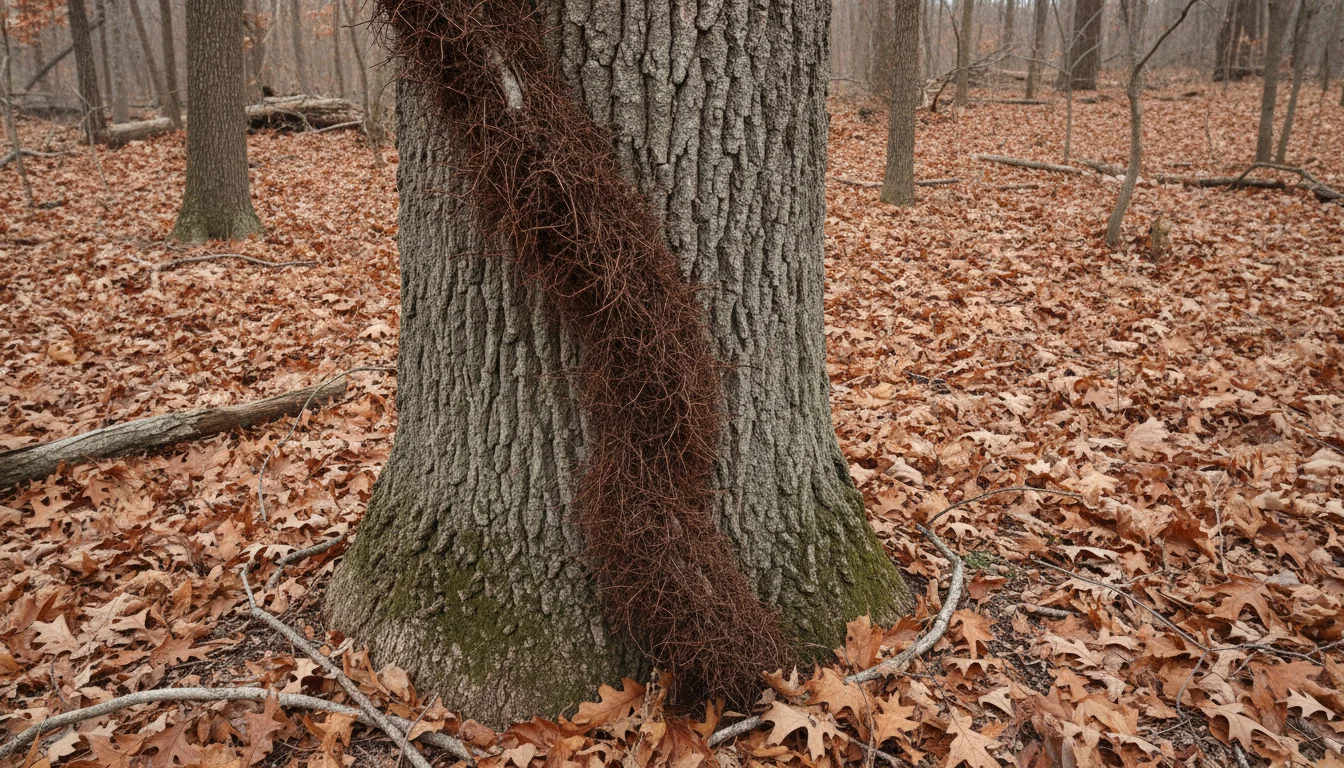
The leaves are gone, the yard looks bare, and that hairy rope up the oak looks like a dead stick. It isn’t. Poison ivy drops its leaves in fall but keeps its oil, urushiol, in the stems and roots, and Clemson Extension says even dead plants and roots can cause a reaction for a couple of years. The CDC says an amount smaller than a grain of salt gives most adults a rash. Learning how to get rid of poison ivy starts there.
So winter isn’t a break from poison ivy. It’s the best time to find it. This guide starts where you are in late fall: how to spot the bare vines, which cuts to make now, and why the string trimmer stays in the shed. Summer methods come after.
Dress for it whatever the season: long sleeves, long pants, closed shoes and waterproof gloves.
What causes this problem
Birds, mostly. More than 55 bird species eat the berries, according to University of Georgia Extension, and Clemson says one dropped seed can become a yard-wide problem. So it turns up along fences and under trees, wherever birds perch.
Then it spreads underground. UGA says leafy shoots can come up from creeping roots several yards from the parent plant. The same plant can be a ground cover, a small shrub or a high-climbing vine with aerial roots on trees, fences and buildings.
UGA says the oil isn’t normally on the surface of intact leaves and stems, but it comes out fast when they’re crushed, bruised or cut. Every method below does that damage, so keep it off your skin.
1. Find and mark the bare vines in winter
Walk the yard after leaf fall, when nothing hides the stems. You’re looking for two things.
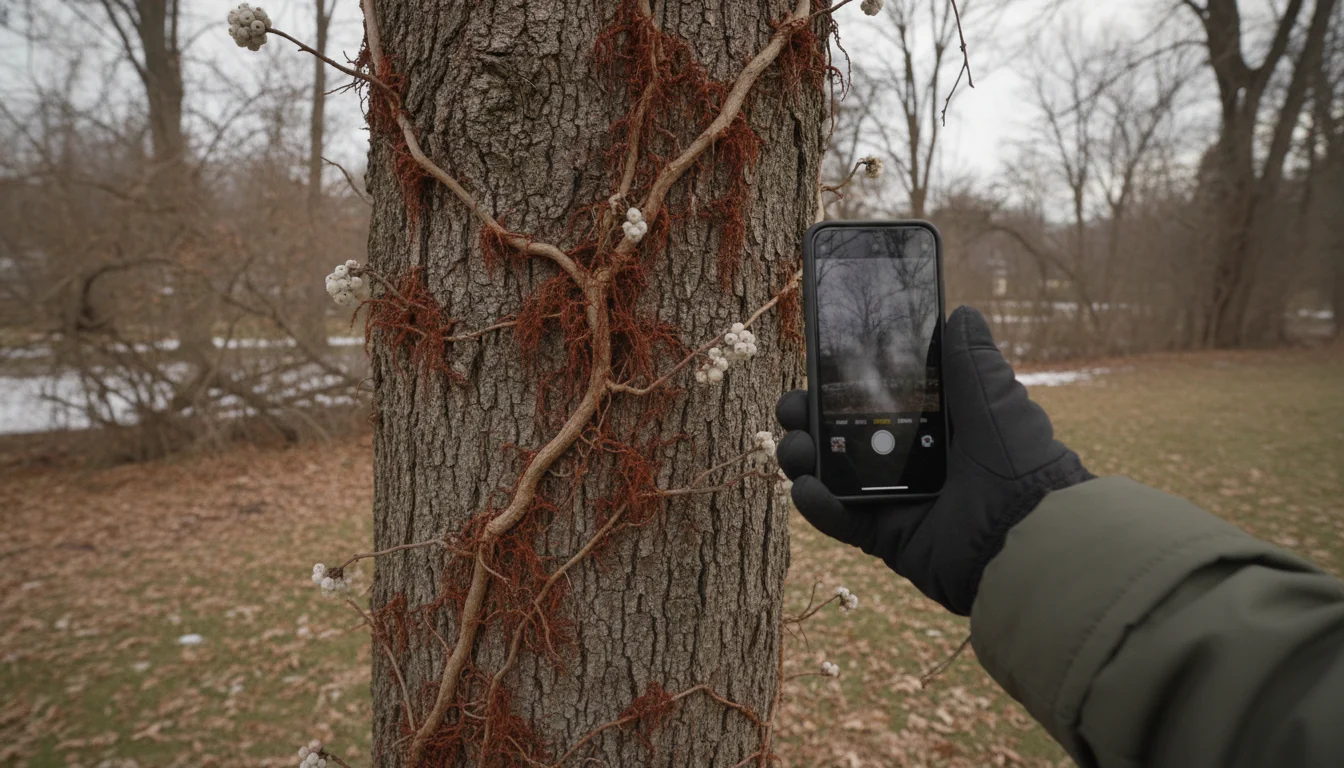
The vine: thick and woody, gripping its tree with dark, hair-like aerial roots. UMass Extension says they make it look like a fuzzy rope. The berries: Mississippi State University Extension says that after the leaves shed, the waxy white berries are an easy giveaway. Birds strip some vines, so no berries proves nothing.
Virginia creeper is the lookalike: House Digest notes it has dark blue berries and thicker, flatter roots. Photograph each vine with its tree in frame so you can come back with loppers. Look, don’t touch. UC IPM, writing about its western cousin poison oak, warns that bare winter stems cause accidental contact, and a damaged stem releases oil.
2. Cut climbing vines at the base and leave them up
This is the winter job. Cut the vine near the soil with loppers or hand pruners, then cut it again about 2 feet (60 cm) higher and lift out the piece between. That gap shows you didn’t miss a stem in the tangle. Everything above dies, the same way creeping fig dies on a wall.
Then leave it. Homes & Gardens points out that ripping vines away releases and spreads the oil, and UNH Extension says the oil stays on stems and roots for a year or more after the plant is controlled. A dead vine in a tree hurts nobody who leaves it alone.
No chainsaw. UMass says a chainsaw or string trimmer can splatter urushiol and cause a severe rash.
3. Paint the fresh cut with herbicide
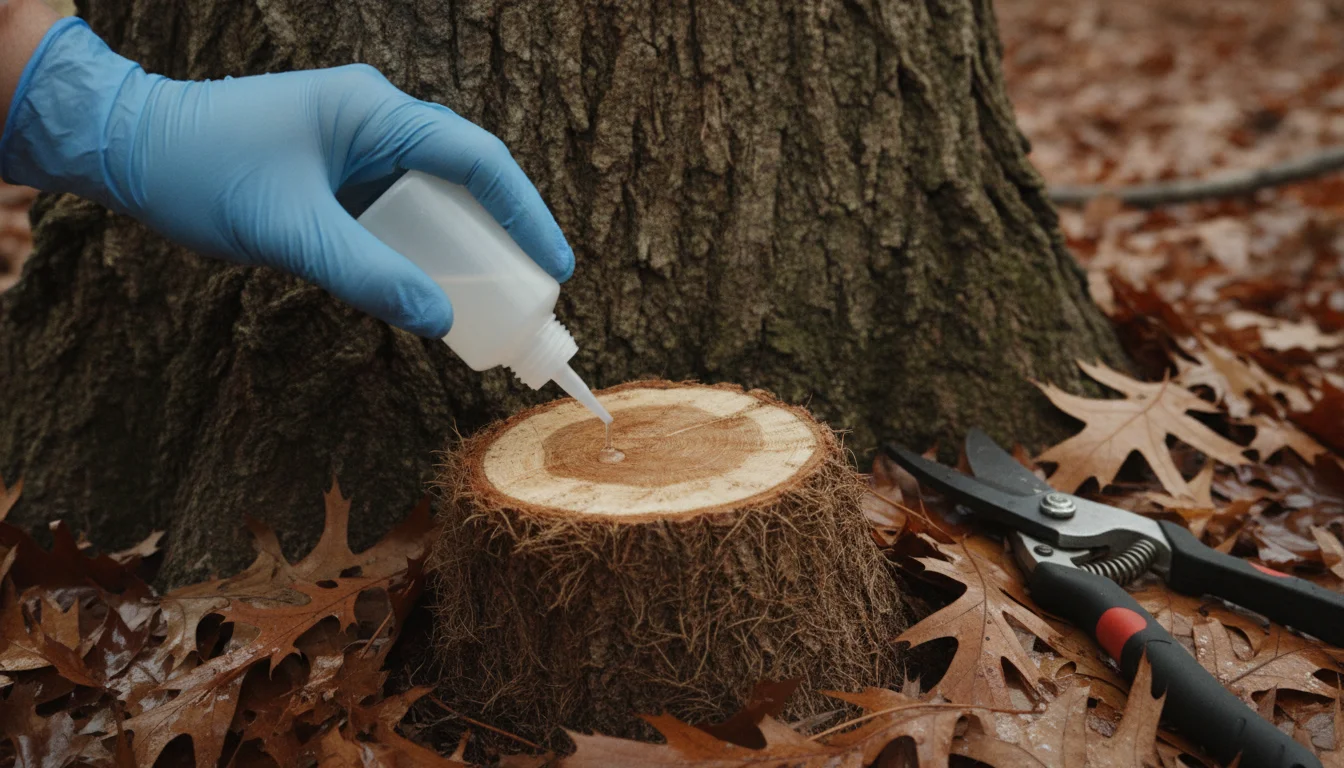
Cutting kills the top, not the roots. So paint the stump you just made.
Wisconsin Horticulture Extension says you can do this at any time of year: cut stems near the soil and paint the cut with a more concentrated herbicide formulation. Use glyphosate or triclopyr, and the label sets the strength. UC IPM’s guidance for its western cousin, poison oak, says cut-stump treatments work best in spring or fall, so check a winter cut for new shoots in spring and paint again if you find them. Speed matters. One r/gardening commenter treats the cut within 15 minutes with a few drops of undiluted triclopyr from a hair-dye applicator bottle. No spraying, so nothing drifts onto the tree.
Clemson says the same for poison ivy growing among plants you want to save: paint only the freshly cut stems.
4. Dig out small plants when the soil is wet
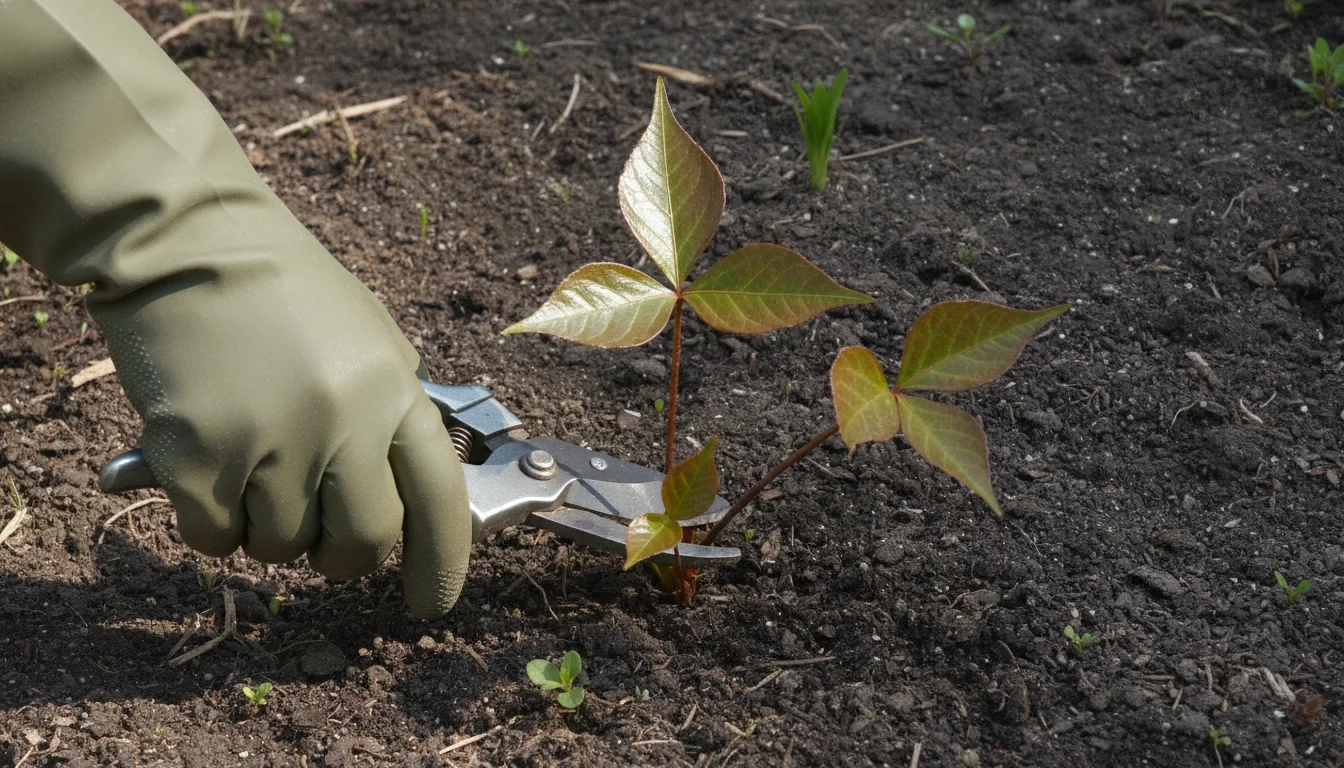
For a few small plants, dig. Cornell says roots come out of wet soil, and Bob Vila’s guide says to go down about 8 inches (20 cm). Follow the roots and take every piece you find, because root sections left behind resprout.
Your hands are the risk here. UMass says digging and hand-pulling the roots can cause severe dermatitis on unprotected hands. Wear waterproof gloves, not cloth. Clemson’s trick is to slide each hand into a long bread bag, secure it with a rubber band, and peel the bags off inside out when you’re done, straight into the trash.
5. Spray the leaves in summer
The fastest way to clear a big patch, once the leaves are back. A systemic herbicide travels from the leaves to the roots. Clemson says triclopyr works best after the leaves fully expand in spring and before they change color in fall, and glyphosate works best from about two weeks before to two weeks after full bloom in early summer, mixed to a 2% solution. UMass says triclopyr leaves lawn grass alone, so pick it where you’re spraying near turf.
Spray on a calm day, and never on a vine growing up a living tree. One r/DIY commenter found a big-box brush killer took out the small plants while the big ones shrugged it off, so expect a second round.
6. Cut the shoots until the roots starve
No herbicide? Cut every shoot back to the ground, again and again, as with most invasive plants that regrow from roots. Clemson says to start in early spring when the leaves unfold, inspect every week or two, and cut whatever is green. UGA says it often takes several cuttings a year for several years.
Use hand pruners. UGA says frequent mowing keeps shoots out of a lawn, but don’t drive a mower or swing a string trimmer through a standing patch. UC IPM says mowing poison oak can put oil particles in the air.
7. Smother it with cardboard
Cut everything to the ground, cover it with cardboard or a tarp, and weigh it down. Lawn Love says 6 to 8 weeks, but a landscaper quoted by Tom’s Guide says months or even years. Watch the edges.
It works best as the last step: an r/DIY commenter’s extension office suggested cutting, spraying, then tarping for 6 weeks. And once the ground is clear, Wisconsin recommends 4 to 6 inches (10 to 15 cm) of clean wood chip mulch to cover any oil left in the soil.
8. Rent goats
Goats eat poison ivy and don’t react to it. One r/HomeImprovement commenter who rented out goats says they cleared about 1,000 square feet (93 m²) of woods in about three days, up to about 6 feet (1.8 m) high, and went for the poison ivy first. UC IPM says sheep and goats work in small areas. Lawn Love says regrowth can mean more visits. And UGA notes that animals can carry the oil to people, so don’t hug the goats.
9. Bag everything and never burn it
Wisconsin says to rake up the leftover berries, leaves, stems and roots, bag them and put them in the trash. Never compost them. And never burn them: the EPA-filed label warns that smoke from burning poison ivy has caused severe injury to skin and to lungs. Seal the bags tight, and the same label says to bin the gloves too.
Prevention
Ohio State says urushiol can stay on clothing, gloves and tools for years if they aren’t washed. Wash work clothes in hot water, apart from other laundry, and wipe tools with rubbing alcohol.
Then keep watching. One r/gardening commenter walks the area at least weekly and treats every seedling the moment it shows. UGA says shoots moving into a lawn from nearby woods keep coming until you control the plant in the woods too.
When to call a professional
Call one if you react badly to poison ivy. Clemson forest health specialist David Coyle told Homes & Gardens that anyone very allergic, or uncomfortable with herbicides, should let a professional handle it.
If the oil does get on you, wash with plain soap and cool running water right away. See a doctor for a reaction on your face or eyes, trouble breathing or swallowing, or after breathing smoke from burning plants.
FAQ
Can you get poison ivy in winter?
Yes. The stems and roots still hold urushiol, and breaking a bare stem releases it.
How long does dead poison ivy stay dangerous?
Years. UMass says urushiol stays active in dead plant material for several years. Bag it, and leave dead vines in trees alone.
Does vinegar kill poison ivy?
Barely. Lawn Love says a vinegar spray works best on young plants and doesn’t kill the roots the way herbicides do, so it takes several rounds. A landscaper quoted by Tom’s Guide says it may not work on large or mature plants at all.
Can I burn poison ivy?
No. The CDC warns that smoke from burning these plants irritates the lungs. Bag it for the trash.